Please click the Follow button below to get updates from The Professor.

Follow this blog

Friday, December 29, 2006

Bluetooth


Two different gentlemen named Richard called in to the last show with opinions on the origin of the copyrighted  trade term Bluetooth. Richard from Kingsley, MI, maintained that the original device was shaped like a tooth and that it had a blue light at one end. Richard from Traverse City, MI, claimed that it was named after Harald Bluetooth (Blatand), a Viking King of the 10th century. Traverse City wins this one.

You’ll find the full story at www.bluetooth.com/bluetooth/  I’ll simply provide a summary. In essence, Bluetooth is wireless technology that allows diverse devices such as mobile phones, PDAs, computers, and other electronic marvels to interconnect at short range without the hassle of cords.

The inventors were Scandinavians. During a discussion about the future of wireless technology, someone made an analogy to King Harald Blåtand, who had united warring factions in Norway, Sweden, and Denmark. Just as he had been a unifying force, so could this new wireless technology bring together diverse instruments without the need for tangled cords.

The name Bluetooth was thus set, and a logo was devised to reflect that association. Using runic characters, the logo contains the letter H, which has the shape of an asterisk, and the letter B. (See top of page)

This has to be one of the more sophisticated ways to name a product.


Check out Mike's latest book here: http://arbutuspress.com/
at Amazon.com


Visit the Senior Corner at http://seniors.tcnet.org

wordmallATaol.com
(substitute @ for AT above)


Wednesday, December 27, 2006

Quarry


Quarry is an interesting word with many meanings. Originally, it referred to scraps given as a reward to successful hunting hounds or to a trained hawk. Eventually, the meaning turned to the victim of the bird of prey or to the animal pursued by a hunter. The base for this word was the Latin corium, skin. This word was also applied to a heap of deer piled together at the end of a hunt--the equivalent of our modern deer pole--and to a pile of human bodies. The verb form could refer to training a hawk or hound or to the actions required to track down the prey.


Another word with the same spelling owes its origin to the Latin quadrare, to square. It was applied to the open pit from which stones and other building materials were extracted. Obsolete meanings of this word included the hard granular part of a pear, a square-headed arrow, a pane of glass, and a square candle. In all cases, the “fourness” of the original Latin can be discerned. The verb form involves the actions needed to extract building materials.


Sidebar:  Virtual Quarry
 

Check out Mike's latest book here: http://arbutuspress.com/
at Amazon.com


Visit the Senior Corner at http://seniors.tcnet.org

wordmallATaol.com
(substitute @ for AT above)


Thursday, December 21, 2006

Happy Holidays!

icon art by dona sheehan


Some say that ever 'gainst that season comes
Wherein our Saviour's birth is celebrated,
The bird of dawning singeth all night long:
And then, they say, no spirit dares stir abroad;
The nights are wholesome; then no planets strike,
No fairy takes, nor witch hath power to charm,
So hallow'd and so gracious is the time.

Hamlet, Act I, Scene i, lines 178 - 184


Check out Mike's latest book here: http://arbutuspress.com/
at Amazon.com


Visit the Senior Corner at http://seniors.tcnet.org

wordmallATaol.com
(substitute @ for AT above)

Wednesday, December 20, 2006

All In Order


Q. I know that the sequence of ranking numbers starts out as primary, secondary, and tertiary, but where does it go after that?
Mike/NYC

A. Here is a partial list of ordinal numbers, all confirmed as legitimate words in the online Oxford English Dictionary:
1. primary
2. secondary
3. tertiary
4. quaternary
5. quinary
6. senary
7. septenary
8. octonary
9. novenary
10. decenary

In all cases, the -ary suffix means connected with or pertaining to. The root section is a letter combination designating a particular number.

• prim- Primacy means being first in order, rank, importance, or authority. Primal urges belong to the first stage or primitive condition. A prime minister is the first or principal minister or servant of any sovereign, ruler, or state.
• second- Second-class is next and inferior to the top. Secondary colors are a mixture or combination of the primary colors (red, green, violet).
• tert- To tertiate is to do anything for the third time. In philosophy, a tertium quid is something undefined that is related in some way to two known things, but is distinct from both of them.
• quat- A quaternion is a set of four poems. Quaternity postulates four persons in the Godhead, in contrast to the traditional Trinity.
• quin- A quincentennial is a 500-year celebration or anniversary. A quintet is a composition for five voices or instruments. NOTE of Caution: sometimes the root -quin- can mean quinine: quininic, quinism.
• sen- A sennight is a period of seven days and nights--a week. Some creatures are senocular; they have six eyes. Most often, sex- is the prefix used to designate six.
NOTE of Caution: most often, sen- signifies old age: senate, senile.
• sept- Septagonal means having seven angles. Septarchy is soverieignty shared by seven rulers. Something septennial lasts for seven years or recurs every seven years.
• oct- If a figure is octagonal, it has eight sides. An ecclesiastical octave lasts for eight days: the festival itself, plus the seven days following. An octavo is a page size produced by folding a standard printing sheet three times to form a section of eight leaves.
• nov- In the Roman calendar, November was the ninth month. Something novemfid consists of nine sections. A church novena involves nine successive days filled with special prayers. NOTE of Caution: most often, nov- signifies new: novelty, novice.
• dec- A decade is a period of ten years. A decagon is a plane figure having ten sides and ten angles. The Decalogue is a set name for the Ten Commandments.


Check out Mike's latest book here: http://arbutuspress.com/
at Amazon.com


Visit the Senior Corner at http://seniors.tcnet.org

wordmallATaol.com
(substitute @ for AT above)

Sunday, December 17, 2006

Seriously Sarcastic

A sarcastic person will chew you up and spit you out, speaking metaphorically. Sarcasm is defined as a sharp, bitter, or cutting remark. Sharpness, ripping, chewing--it’s almost like watching an animal tear flesh from a bone. And that’s an entirely appropriate image, since the Greek origin of the word, the verb sarkazein, meant to tear flesh.

Sarco-, a combining form from the Greek word meaning flesh, is very useful in scientific terminology, as the following examples will show.
• Sarcoderm: The fleshy layer in some seeds lying between the internal and external integuments.
• Sarcoid: resembling flesh
• Sarcolite: A silicate of aluminum, sodium, and calcium found in flesh-colored crystals.
• Sarcology: That branch of anatomy which treats of the fleshy parts of the body.
• Sarcophagal: Flesh-devouring, flesh-consuming.
• Sarcotic: Producing flesh; inducing the growth of flesh
• Sarcotome: an instrument for painlessly cutting through the soft tissues of the body.

The terminal combining form -sarc is used in fewer words, but they, too, are scientific in nature, occurring mostly in zoology.

• Cenosarc: The common living basis or ‘flesh’ by which the several individuals forming a compound zoophyte, or polypidom, are united together.
• Endosarc: the inner sarcode-layer of certain rhizopods, such as the amoeba.
• Perisarc: An enclosing horny or chitinous layer secreted by many colonial hydroids.

Some -sarc- words are not very pretty to picture, as anasarca (a dropsy producing a very puffed appearance of the flesh), or polysarcia (excessive accumulation of fat).

Finally, an APA report indicates that scientists may have found the area of the brain responsible for interpreting sarcasm.


Sidebar: sarcastic quotations


Check out Mike's latest book here: http://arbutuspress.com/
or at Amazon.com


Visit the Senior Corner at http://seniors.tcnet.org


wordmallATaol.com
(substitute @ for AT above)


Thursday, December 14, 2006

Gudgeon Goes to Hawaii

Q:   My mother used to say, “I searched from stem to gudgeon.” I never did find out what a gudgeon is. Can you help?
Charlie/Torch Lake, MI

A.   My first reaction was that it sounds like a variation on the far more common “stem to stern,” and that turns out to be correct. Before that show was over, listener Charles from Atwood, MI, volunteered that you might have misheard the word escutcheon as a child, accidentally turning it into gudgeon.

An escutcheon was the shield-shaped surface on which a coat of arms was painted. In nautical terms, it was the plate bearing the vessel’s name, and it was placed, almost universally, at the back end of the ship--an early version of a license plate. This is confirmed by Smyth’s Sailor’s Word Book, 1867, which placed the escutcheon smack dab in the middle of the ship’s stern.

But the word gudgeon actually exists; it is not just a corruption of escutcheon. The Oxford English Dictionary has this: “Nautical: A metal socket in which the pintle of a rudder turns.” That sent me scrambling to find pintle, which the OED defines as, “A pin forming part of the hinge of a rudder, usually fixed on the rudder and fitting into a ring on the sternpost.”

Word buffs or readers of underground Victorian novels will also recognize pintle as a synonym for the male organ.

The stem, of course, was the curved upright timber at the bow of a vessel, so whether you use stem to stern, stem to gudgeon, or stem to escutcheon, the meaning is from front to back.

Sidebar:  USS Gudgeon SS 567


Check out Mike's latest book here: http://arbutuspress.com/
or at Amazon.com


Visit the Senior Corner at http://seniors.tcnet.org


wordmallATaol.com
(substitute @ for AT above)


Sunday, December 10, 2006

Motto, Otto


Do yourself a favor and save some money: instead of hiring an expensive life coach, create a motto for yourself. If it’s potent enough, you can chant it in times of need and fill yourself with inspiration.

A motto is a short sentence or phrase used to express a principle, a goal, or an ideal. In the old days, mottoes were rife. They were used by institutions, by families, and by individuals to render a quick snapshot of essence and purpose. We still find them on currency: In God We Trust adorns American money; Canada uses From Sea to Sea (A Mari usque ad Mare). The European Union adopted United in Diversity as its motto, and Oxford University proclaims The Lord is My Light (Dominus Illuminatio Mea) on its coat-of-arms.

Motto probably took its form from the French mot (utterance, word, or saying), as in bon mot, a clever or witty saying. As several of the mottoes used above show, it was considered proper to cast the motto in Latin. I devised the motto Natus Ad Cogitandum to plaster on my motorbike helmet. Thus, my antidote to Born to Raise Hell was Born to Think. The motto of my teaching career (and of my current radio program) was taken from Wittgenstein: The limits of my language are the limits of my world. That would be more motto-like if it were shortened to something like, Small Vocabulary, Small World.

It’s probably better if you invent an utterly personal motto, but there’s no problem with borrowing one; that’s as legitimate as a couple choosing “our song” from what’s on the charts. Here are some to ponder:

• Animus, non res: Mind, not property.
• Aude aliquid dignum: Dare something worthy.
• Bene agendo nunquam defessus: Never weary of doing good.
• Concussus surgo: When struck, I rise.
• Dum spiro spero: As long as I breathe, I hope.
• Feriunt summis fulmina montes: Lightning strikes the mountain tops.
• Ingenium superat vires: Genius overcomes strength.
• Nivem flavam noli comedere: Don’t eat yellow snow.
• Non quam diu, sed quam bene: Not how long, but how well.
• Quod in te est, prome: Bring forth what is in you.
• Sol non occidat super iracundiam vestram: Let not the sun set on your anger.
• Usus libri, non lectio prudentes facit: The use, not the reading, of a book makes men wise.

Sidebar: state mottoes


Check out Mike's latest book here: http://arbutuspress.com/
at Amazon.com

Visit the Senior Corner at http://seniors.tcnet.org

wordmallATaol.com
(substitute @ for AT above)

Monday, December 04, 2006

Good, Bad, Indifferent


Q:   I always thought the saying was “take the bad with the good,” but I have been coming across its opposite: “take the good with the bad.” Reversed, it just doesn’t make sense to me.
Dan/Bellaire, MI


A:   An interesting question. I hadn’t noticed that a reversal was taking place until I read your note. My sense is that the saying should be “take the bad with the good,” as you believe, since accepting good things is so very easy and natural. We don’t have to “put up with” good things, but we have to deliberately stir up a sense of proportion and balance to accept bad things, something that takes effort.

So I was surprised when I ran the Google Test. 50,100 sites think it should be “take the bad with the good.” 171,000 sites think it should be “take the good with the bad.” I’m at a loss to explain why the reversal has taken place and why it now enjoys a 3 to 1 margin.

It reminds me of the saying, “he’s head over heels in love.” Our head is supposed to be over our heels! It’s topsy-turvy only if the heels are over the head. Research shows that the original 14th century phrase was “heels over head.” Somehow, the order was reversed, and the one that makes less sense took over.

Two similar proverbs or sayings place the negative element first. In Troilus and Cressida, Chaucer used a variant on “to take the bitter with the sweet.”

“For how might ever sweetnesse have be knowe
To him that never tasted bitternesse?
Ne no man may be inly glad, I trowe,
That never was in sorwe or som distresse;” [lines 638-641]


A work known as the Tale of Beryn (a later insertion into Chaucer’s The Merchant’s Tale) presages our “to take the rough with the smooth.”

“Take yeur part as it cometh, of roughe and eke of smoth.” [line 1152]


Sidebar: proverbs


Check out Mike's latest book here: http://arbutuspress.com/
at Amazon.com


Visit the Senior Corner at http://seniors.tcnet.org

wordmallATaol.com
(substitute @ for AT above)


Thursday, November 30, 2006

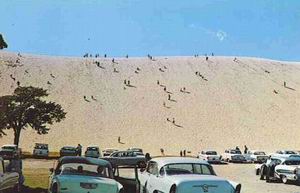
The Sandwich Is There


The headline above is part of the punch line of a hoary pun, of course:

Q. Why can’t you starve in the desert?
A. Because of the sand which is there.

Word parts denoting sand show up in some $2 words, and that makes them interesting.

The combining form ammo- comes from the Greek word ammos, sand. There is ammocoete, the larval form of various lampreys (sand + bed). Then there’s the ammodyte, a venomous snake (sand + burrow/dive). And there are plants and insects that live exclusively near sand; they are ammophilous (sand + loving).

The Latin formation aren-, as most people know, gave the name to the arena, a combat zone covered in sand to soak up blood and guts. Anything arenacious has the form or appearance of sand. Arenicolite is a worm-hole originally made in sand, then preserved in sandstone rock. And arenicolous (sand + dwelling) means the same as ammophilous.

The Greek form psamm- shows up in many scientific terms. Add psammophilous (sand + loving) to arenicolous and ammophilous. A psammophyte is a plant found in sandy soil. A psammosarcoma is a fleshy tumor with sand-like particles.

Sabul- owes its existence to the Latin sabulum, sand. “Darling, you look sabulous” is something you may say to a friend whose hair is covered in sand. Sabulosity is an obsolete term for sandy, and sabuline doubles as a synonym for sabulous.

Finally, the Latin saburr- (sand) is a close cousin of sabul-. Saburra is a foul granular matter deposited in the stomach. To saburrate is an obsolete verb meaning to place ballast in a ship. And in ancient medicine, saburration--applying heated sand to the body--was seen as salubrious.

Sidebar: Mr. Sandman


Check out Mike's latest book here: http://arbutuspress.com/
at Amazon.com


Visit the Senior Corner at http://seniors.tcnet.org

wordmallATaol.com
(substitute @ for AT above)

Monday, November 27, 2006

One Singular Sensation: hapax legomenon


I have been asked to share the strangest term that I know. One of the top contenders has to be hapax legomenon.

A hapax legomenon is a word or grammatical structure that occurs only once in the entire written record of a language, only once in the complete works of a particular author, or only once in a single text. It comes from two Greek words: hapax (once only) and legomenon (having been said).

Linguists--especially those who work with ancient languages--pay particular attention when they find a single instance of a word unconfirmed anywhere else in a work.

For one thing, it makes it difficult to render an accurate translation. They must become even more acutely aware of context and what it can reveal about the term. For another, they must weigh the possibility that the word or structure is simply a typo or the product of mishearing. They don’t enjoy the security afforded by multiple instances in a variety of contexts.

Biblical scholars in particular must deal with this reality. The Jewish Encyclopedia points to about 400 unique, unconnected terms in the Old Testament. They occur in the Song of Songs, the Book of Job, and in passages dealing with detailed lists, such as Leviticus or Deuteronomy.

On the extra-biblical scene, Chaucer uses the word nortelrye in the Reeve’s Tale:
/ Hir thoghte / þat a lady sholde hir spare / What for hir kynrede /
and hir nortelrye / That she hadde lerned / in the Nonnerye /. . . .
The word seems to mean education, but it never shows up again.

And in Love’s Labour Lost, Shakespeare used the word honorificabilitudinitatibus, evidently for the first and only time in his works. The character Costard says,
O, they have lived long on the alms-basket of words.
I marvel thy master hath not eaten thee for a word;
for thou art not so long by the head as
honorificabilitudinitatibus: thou art easier
swallowed than a flap-dragon.

The singularity concept found in hapax also appears in the combining form haplo-, though they are not directly connected.

• Haplology is the utterance of one letter, syllable, or word instead of two.
• A haplodont has crowns of the molar teeth that are simple or single, and not divided into
ridges, etc.
• Haplography is single writing; the unintentional writing of a letter or word, or series of
letters or words, once, when it should be written twice.

Sidebar: Haplology and vowel underspecification


Check out Mike's latest book here: http://arbutuspress.com/
at Amazon.com


Visit the Senior Corner at http://seniors.tcnet.org

wordmallATaol.com
(substitute @ for AT above)

Friday, November 24, 2006

I've Got A Secret


There are a number of interesting terms denoting secrecy. Let’s focus on four of them in this posting.

furtive:
Done by stealth or with the hope of escaping observation. Originally a Greek word, it morphed into the Latin fur (thief) and furtum (robbery). Since then, the elements of hidden action and slyness have been emphasized.

covert:
Concealed, hidden, secret, disguised. The Latin verb co-operire ( to cover completely) is the parent of our word. In recent decades, "covert operations" has been a stock phrase for government/military actions.

surreptitious:
Clandestine, skulking, on the sly. The Latin words sub (under) and repere (to creep) combined to form this word. A snake in the grass comes to mind.

clandestine:
Secret, private, concealed. The Latin clandestinus (secret, private) provides a straight transaction here. Sometimes the word merely designates a fierce desire for privacy, as in a clandestine marriage, but clandestine council meetings are not appreciated by voters.

Of the four terms, covert is the most clinical, surreptitious introduces an undertone of extreme caution, clandestine often involves illicit actions, and furtive hints of guilt and evasion.


Check out Mike's latest book here: http://arbutuspress.com/
at Amazon.com


Visit the Senior Corner at http://seniors.tcnet.org

wordmallATaol.com
(substitute @ for AT above)

Wednesday, November 22, 2006

Xeno: Warrior Stranger


Happy Thanksgiving, Pilgim!


John Wayne may have encountered quite a few pilgrims, but he didn’t seem to be afraid of them. Come to think of it, though, his best advice was to sit with your back to a wall when visiting a rowdy saloon.

If he had been afraid of strangers, he would have been termed a xenophobe (pronounced zeenophobe). This is because the Greek segment xeno- comes from a word that means stranger or foreigner. Phob- indicates strong aversion or even fear. The Duke would not have been so tolerant if things had led to a xenocracy (ruling body of foreigners).

One of the stranger pursuits is xenobiology, which studies extraterrestrial life forms. I suppose it’s confined to Area 51.

The word part xeno- is particularly useful in zoology and in medicine, where we encounter terms such as xenobiotic (foreign to the body or to living organisms), xenograft (in which the donor and the recipient come from different species), or xenophthalmia (presence of a foreign body in the eye).

Don't be a stranger, now, hear?


Check out Mike's latest book here: http://arbutuspress.com/
at Amazon.com


Visit the Senior Corner at http://seniors.tcnet.org

wordmallATaol.com
(substitute @ for AT above)

Monday, November 20, 2006

Pilgrim's Progress


Americans will celebrate Thanksgiving this week, and the word Pilgrims will inevitably arise.

Pilgrim is a word that was used by John Wayne in several of his westerns, usually addressing a stranger on his way through town. That was entirely appropriate.

The word started life in Latin as two words: per (through) and ager (field). This led to the word pereger, someone traveling abroad. That, in turn, led to peregrinus, a foreigner. Over the course of centuries, this was transmuted in English to pilgrim.

We have retained the fancy word peregrination to denote a journey, and we know that there is a peregrine falcon. In Gregorian chant, there was a Peregrine Tone, an unorthodox set of notes that wandered more than usual. And the British satirist Tobias Smollett wrote a novel entitled, The Adventures of Peregrine Pickle, poking fun at the Grand Tour concept of his day.

Cease your peregrinity, Pilgrim, and rest your spurs awhile.


Check out Mike's latest book here: http://arbutuspress.com/
at Amazon.com


Visit the Senior Corner at http://seniors.tcnet.org

wordmallATaol.com
(substitute @ for AT above)

Thursday, November 16, 2006

East Is East


Orienteering is a sport or pursuit growing in popularity. The purists use compasses and folding maps. Their wealthier counterparts carry elaborate and expensive GPS devices. In all cases, getting your directions straight is the goal.

The older amongst us will remember Lamont Cranston, “who, while in the Orient, learned the power to cloud men’s minds.” Even if you don’t remember The Shadow, you know that the Orient stands for the Asian nations.

It started before compasses. One of the simplest directions to discern for the Romans was oriens, that point on the horizon at which the sun rises each morning. In the European Christian era, since Jesus’ homeland was to the east, it was a requirement that altars be oriented—facing east, that is.


Check out Mike's latest book here: http://arbutuspress.com/
at Amazon.com


Visit the Senior Corner at http://seniors.tcnet.org

wordmallATaol.com
(substitute @ for AT above)

Monday, November 13, 2006

You Are My Sunshine


Sunbeam is a warm, comfort-filled word, but quirky nonetheless. It is, of course, a ray of sunshine, so the sun- segment makes perfect sense, but what about a beam? I associate that with the huge piece of timber used in construction to hold up the roof.

As it turns out, so did the scholar who invented the word. We’re talking about Alfred the Great, famous for building up the storehouse of Old English literature by translating books from Latin.

While he was translating Bede’s Historia ecclesiastica gentis Anglorum (Ecclesiastical History of the English People), he kept bumping up against the image columna lucis, rendered as “column of light” in modern English. Old English did not contain the word column, so Alfred reached for the nearest reality in his day: bêam, a tree or building post.

So a sunbeam was a sun post was a columna lucis.


Check out Mike's latest book here: http://arbutuspress.com/
at Amazon.com


Visit the Senior Corner at http://seniors.tcnet.org

wordmallATaol.com
(substitute @ for AT above)

Friday, November 10, 2006

Flagrantly Blatant


Blatant and flagrant are often treated as synonyms, something that throws language purists into conniption fits. “Conspicuously reprehensible” sums up the shared meaning.

The American Heritage Dictionary
prefers blatant if you are referring to the shameless in-your-face nature of the act, and flagrant if you are emphasizing the serious moral failure at the heart of the act.

Blatant is a word that was either invented or adapted by Edmund Spenser in his Fairie Queene. It was probably related to the word bleating, and it may owe its existence to the Latin blatire, to babble. Today, it is a word that depends upon sight, but originally, it related to the auditory sense. In fact, for a couple of centuries, its sole meaning was noisy or clamorous.

Flagrant owes its existence to the Latin flagrare, to burn. Glowing, fiery, and hot were the original meanings, but by the 18th century, it had taken on the sense of notorious or scandalous.

If you are prone to outbursts of censoriousness, there are other fine words at your disposal: atrocious, audacious, brazen, disgraceful, flagitious, glaring, gross, heinous, monstrous, nefarious, outrageous, rank, scandalous, and shocking. I can feel the temperature rising.


Check out Mike's latest book here: http://arbutuspress.com/
at Amazon.com


Visit the Senior Corner at http://seniors.tcnet.org

wordmallATaol.com
(substitute @ for AT above)

Wednesday, November 08, 2006

Nausea


We all know that it’s easy to be queasy, especially on roller coasters and airplanes. The word nausea took root in an ancient form of travel.

In Greek, a nautes was a sailor, and he shipped out on a naus. So the original nausea was seasickness, though it has expanded to many potential causes and is even used to signify emotional or ethical loathing.

By the way, its inelegant cousin, puke, seems to be onomatopoetic: it imitates the sound made by a person throwing up. Oddly enough, William Shakespeare may have been the first writer to use the word. In Jacques’ Seven Ages of Man speech (As You Like It), we find, “At first the infant, mewling and puking in the nurse's arms.”


Sidebar: Selection from Jean Paul Sartre, Nausea


Check out Mike's latest book here: http://arbutuspress.com/
at Amazon.com


Visit the Senior Corner at http://seniors.tcnet.org

wordmallATaol.com
(substitute @ for AT above)

Monday, November 06, 2006

Bob, Bob, Bobbin' Along


Q. Where does the term “plumb bob” come from?
Mark, Traverse City, MI

A. A plumb bob is a piece of metal suspended on a string. It is used to establish straight vertical lines. Often, the string is chalked and then snapped while taut to draw a perfect line.

The plumb part comes from the Latin plumbum, which meant lead, the metal. It seems that the Romans used lead pipes to conduct water because the substance was easy to work with. Some have speculated that lead poisoning contributed to the downfall of the Roman Empire, but most authorities disagree. At any rate, the original plumbers were lead workers.

The origin of bob is uncertain. It may come from the verb to bob since the weight, when first dropped, bounces a bit. Fishermen are familiar with bobbers, plastic or cork floaters that bounce up and down with the waves, and mariners plumbed the depths by dropping a metal weight suspended on the end of a rope. Another explanation points to the Middle English word bobbe, a cluster of fruit, due to a supposed resemblance between the chunk of metal and grapes. According to the Oxford English Dictionary, bob is still used in Scotland to designate a bouquet--or cluster--of flowers.

A versatile word, bob can also mean a knob, a sleigh runner, an earring, a knot of hair at the back of the head, a horse’s tail docked short, a woman’s short hair style, the weight on the tail of a kite, a lump of clay used by potters, and the grub of a beetle.


Check out Mike's latest book here: http://arbutuspress.com/
at Amazon.com


Visit the Senior Corner at http://seniors.tcnet.org

wordmallATaol.com
(substitute @ for AT above)

Thursday, November 02, 2006

Muscling In


A muscle man may drive a muscle car and try to muscle in where he’s not appreciated, but even he can’t escape the age-old question: are you a man or a mouse?

In Latin, musculum meant a little mouse. The conceit was that the rippling of muscles under the skin (think biceps, for instance) looked very much like the motion of mice under a piece of cloth or sacking.

The Greeks had the same idea. For them, the word mys had two equally apt meanings: field mouse and muscle. From that source we derived the much-used medical combining form myo- (muscle): myoatrophy, myocardial, myocele, and dozens more.


Check out Mike's latest book here: http://arbutuspress.com/
at Amazon.com


Visit the Senior Corner at http://seniors.tcnet.org

wordmallATaol.com
(substitute @ for AT above)

Monday, October 30, 2006

Feline Frisky


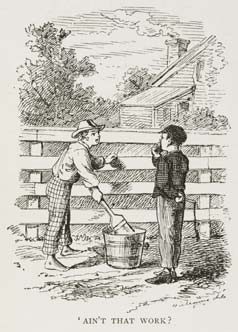
Q. I’ve been reading Tom Sawyer with my children, and we’ve come across a word that has us stymied: maow. Was that a slang term in Mark Twain’s day?
Amy/Suttons Bay, MI


A. Actually, it’s a case of imitative spelling. Let’s take a fast look at the word in context:


The night promised to be a fair one; so Tom went home with the understanding that if a considerable degree of darkness came on, Huck was to come and "maow," whereupon he would slip out and try the keys. [Ch. XXVIII]

All you got to do is to trot up Hooper Street a block and maow -- and if I'm asleep, you throw some gravel at the window and that'll fetch me." [Ch. XXVIII]

"Well, if I don't want you in the daytime, I'll let you sleep. I won't come bothering around. Any time you see something's up, in the night, just skip right around and maow." [Ch. XXVIII]

Tom's excitement enabled him to keep awake until a pretty late hour, and he had good hopes of hearing Huck's "maow," and of having his treasure to astonish Becky and the picnickers with, next day; but he was disappointed. No signal came that night. [Ch. XXIX]


So "maow" is a vocal signal worked out by the boys. It’s an imitation of the sound that a cat would make, the kind of sound that wouldn't alarm a casual listener or betray the boys’ presence. In our day, we're more likely to spell it meow.

Sidebar: All about the sounds cats make


Check out Mike's latest book here: http://arbutuspress.com/
at Amazon.com


Visit the Senior Corner at http://seniors.tcnet.org

wordmallATaol.com
(substitute @ for AT above)

Friday, October 27, 2006

Luna Sea


While lunatic is used to designate a crazy or very foolish person, these days we use a much softened sense of this word. “He’s a lunatic” can be said with fondness and admiration; think Bill Murray.

A few centuries back, lunatic and insane were a technical pair. Insanity was a permanent condition, chronic in nature. Lunacy was intermittent; there were periods of lucidity.

But what triggered the bouts of lunacy? The ancient Romans thought they knew: it was the phases of the moon. A waxing moon brought lucidity; a full moon brought out the wolf man in us.

And the Latin word for moon? It was luna, of course.


Check out Mike's latest book here: http://arbutuspress.com/
at Amazon.com


Visit the Senior Corner at http://seniors.tcnet.org

wordmallATaol.com
(substitute @ for AT above)

Wednesday, October 25, 2006

Superscript

script
super


Q. Why do some words in the dictionary have raised numbers? Two examples are forte-1 and truck-2.

A. Those raised numbers are called superscripts, and they are used with words that have identical spellings but come from totally different sources.

For instance, you'll find pedo-1 and pedo-2 listed as prefixes. The first comes from a Greek word meaning soil; the latter comes from a Greek word meaning child. And even though children are notorious for getting dirty, the identical spellings are a sheer accident of history.


I'm going to pair that answer with another one:


Q. I was wondering about the word "stat" that doctors use for hospital emergencies. The dictionary definition is "a clipped form of statistic." Is that the origin of the word?

A. The "stat" in medical circles comes from the Latin word statim, an adverb which meant "at once" or "instantly." As it turns out, the medical "stat" has no connection with the word statistics.

That word ultimately came from a Latin word that meant position or form of government. State and statute share the root with statistics.

If you look at your dictionary again, you'll find stat-1 and stat-2. The spellings are identical, but the etymologies are not.

[NOTE: this program does not support superscripts]


Check out Mike's latest book here: http://arbutuspress.com/
at Amazon.com


Visit the Senior Corner at http://seniors.tcnet.org

wordmallATaol
(substitute @ for AT above)

Monday, October 23, 2006

! ?


Q. Mike/NYC: "I love the use of 'slam' vocally to indicate an exclamation point. Is there a similar term for a question mark? A friend told me to use the word quirk, but that doesn’t sound right.”

A. Aside from its normal meaning (an idiosyncrasy) the Oxford English Dictionary has a couple of quirky meanings for quirk:

• A diamond-shaped piece of leather inserted at the junction of the fingers with the palm in some makes of gloves
• An irregular pane of glass

But it doesn’t refer to the question mark.

I think you’re looking for the word query: “A notation, usually a question mark, calling attention to an item in order to question its validity or accuracy.” [AHD-4]


You called the exclamation point a slam. Typesetters and printers also refer to it as a bang, a screamer, or a smash. Obviously, it’s a punctuation outburst that should be used sparingly; it’s a mark that borders on hysteria!!!!


Check out Mike's latest book here: http://arbutuspress.com/
at Amazon.com


Visit the Senior Corner at http://seniors.tcnet.org

wordmallATaol.com
(substitute @ for AT above)

Friday, October 20, 2006

Bend Sinister


Q. I'm reading a mystery novel and have come across the phrase "bend sinister." Sinister makes sense because evil is being threatened. Does the phrase imply that disaster is just around the bend or corner?

A. Not a bad reconstruction, but bend sinister is a term from heraldry. It's something that would appear on a coat of arms. Odds are that you're reading a British mystery novel.

The bend sinister is a band that runs from the bottom left side to the upper right side of a shield. (Sinister means "left" in Latin.) It often signifies that there was bastardy in the family lineage, but there are exceptions, depending on nationality.

There is also confusion as to whether the band should run from top left or top right. A definitive source (James Parker, A Glossary of Terms Used in Heraldry, 1894) says this: "As shields are always supposed to be upon the arms of the bearer, it is his left-hand side which is meant; consequently the sinister is on the spectator's right hand."

One more reason why the rich are different than you and me.


Check out Mike's latest book here: http://arbutuspress.com/
at Amazon.com


Visit the Senior Corner at http://seniors.tcnet.org

wordmallATaol.com
(substitute @ for AT above)

Tuesday, October 17, 2006

Knapsack


Knapsack

This word figures prominently in the song Happy Wanderer, a German import
sung by generations of American Scouts:

“I love to go a-wandering
Along the mountain track.
And as I go, I love to sing,
My knapsack on my back.”

The –sack half of the word is obvious. Americans tend to use the word backpack, but it’s the same convenient carrier.

The history of the knack- portion is a bit less obvious, but according to the Oxford English Dictionary, it seems to come from
German and/or Dutch words meaning to eat or to bite. Those words, in turn, came from an earlier word meaning to crack something or to chip a stone. The implication, therefore, is that it’s the kind of eating where you bite off small pieces of something, rather than sitting down to a sumptuous dinner.

So the knapsack was a snack sack—food on the run.


Check out Mike's latest book here: http://arbutuspress.com/
at Amazon.com


Visit the Senior Corner at http://seniors.tcnet.org

wordmallATaol.com
(substitute @ for AT above)

Friday, October 13, 2006

Danger, Will Robinson!


JEOPARDY

Aside from being the thinking person’s favorite game show, today jeopardy is a relentlessly one-sided word. It screams danger and peril, the possibility of losing life, property, reputation, freedom, or anything else that we prize.

But when the word started, it was less one-sided; it was more balanced and equitable. In Old French, it was geu parti, and it meant a divided game, divided in the sense of a 50/50 chance for either side to win.

It involved a game that depended upon strategy, such as chess, a game that could go either way. The geu segment derived from the Latin jocus, a jest or a joke. No one's life was in danger.

By the 14th century, jeopardy had picked up the univocal sense of risk and danger, a radical departure from its original meaning.


Check out Mike's latest book here: http://arbutuspress.com/
at Amazon.com


Visit the Senior Corner at http://seniors.tcnet.org

wordmallATaol.com
(substitute @ for AT above)

Wednesday, October 11, 2006

Fearful/Fearsome


Q. What do you make of this sentence, from a Sunday feature article? "Given their massive size, dinosaurs must have been fearful creatures."

A. Fearful was the wrong word to use. Break fearful apart, and you'll see that it means full of fear, which would not be characteristic of the biggest kid on the block.

The writer should have used fearsome, which means able to cause fear. That –some word part, in the sense of characterized by, shows up in awesome, bothersome, cumbersome, gruesome, and dozens of other words, and in most cases, the direction is usually outward; the effect is on others, not on the subject itself.

Be careful, though. There are at least three –some suffixes, all with different meanings and different sources.

• characterized by: adventuresome, handsome, lonesome
• of a certain number: twosome, threesome, foursome
• pertaining to the body: centrosome, chromosome, monosome


Check out Mike's latest book here: http://arbutuspress.com/
at Amazon.com


Visit the Senior Corner at http://seniors.tcnet.org

wordmallATaol.com
(substitute @ for AT above)

Monday, October 09, 2006

Fulcrum


A fulcrum is defined as the point or support on which a lever pivots. I always associate it with classical physics, probably because of Archimedes’ famous boast: "Give me a place to stand and with a lever I will move the whole world." That place to stand would have been his fulcrum.

However, according to the origin of the word, Archimedes could have saved his energy and stayed in bed. The Latin verb fulcire meant to support or prop up, which fits in nicely with the fulcrum/lever image.

But when the noun fulcrum developed from that verb, it had a quite specific meaning. It meant a bed post or foot. There were usually four of them, and their function was to raise the bed from the drafty floor.


Check out Mike's latest book here: http://arbutuspress.com/
at Amazon.com


Visit the Senior Corner at http://seniors.tcnet.org

wordmallATaol.com
(substitute @ for AT above)

Friday, October 06, 2006

Archaic/Obsolete


Q. What's the difference between an archaic word and an obsolete word?

A. Both dictionary labels warn you that the word in question may be hopelessly out of date and should be replaced with something more contemporary.

Archaic or obsolete words survive because people still read the literature of earlier centuries and need to know certain terms. Try getting through the King James Version of the Bible without a glossary, for instance.

An archaic term is no longer in use except in special cases such as poetry or liturgy; it comes from an earlier time.
It will sometimes show up in print as a misguided attempt at humor: Forsooth, that rapper really gets down, dawg.

An obsolete word is stone cold dead. It simply hasn't been used for the last 250 years, even in poetry or liturgy, and it survives merely as a historical curiosity. (Recall Hamlet's "Who would fardels bear . . .)

Then there's the term obsolescent, which refers to a word in the process of becoming obsolete. Alexander Pope had it right: "Be not the first by whom the new are tried, Nor yet the last to lay the old aside."


Check out Mike's latest book here: http://arbutuspress.com/
at Amazon.com


Visit the Senior Corner at http://seniors.tcnet.org

wordmallATaol.com
(substitute @ for AT above)

Wednesday, October 04, 2006

Try TO vs. Try AND


TRY TO vs. TRY AND


Q. Could you comment on these two sentences:

• Please try and avoid excessive noise in the
lunchroom.
• Please try to avoid excessive noise in the
lunchroom.

I was taught that the second version is correct.
Nanette/Cheboygan, MI


A. Most grammarians will endorse your position, at least in formal writing or speechmaking. The tradition is that when the first verb is a command or a strong request
(the imperative mood), the verb that follows should be in the infinitive form (to + verb):

Try to avoid excessive noise.
Come to see us when you get a chance.
Be sure to get an application form on the way out.

However, in informal use, the word and often replaces the word to:

Try and avoid excessive noise.
Come and see us when you get a chance.
Be sure and get an application form on the way out.

Remember that grammar rules are arbitrary; they are not based on something inherent in the language, something that can never change. They are based on custom or style, realities that can and will change over long periods of time.

Think of grammar rules as temporary conventions that may work for a few generations, sometimes longer. The only reason they are useful is to ensure that we are all on the same page. When the page turns and new rules evolve, there is no problem, no violation of something sacred, as long as we still understand each other. Understanding is the point; grammatical conventions are merely a tool.

In practice, this means that the formal rule articulated above is not engraved in stone. Here’s an example from 1813 that breaks the rule. The writer is Jane Austen, one of the finest English stylists in the last two hundred years.

“Now I will try and write of something else.” [Letter, January 29, 1813]

Not even the Grammar Police will dare to arrest her for that.


Check out Mike's latest book here: http://arbutuspress.com/
at Amazon.com


Visit the Senior Corner at http://seniors.tcnet.org

wordmallATaol.com
(substitute @ for AT above)

Tuesday, October 03, 2006

Little Pitchers


Q. My grandfather used to say "Little pitchers should be seen and not heard." Do you know what that means?

A. I can reconstruct a meaning, though I never heard it expressed exactly that way before.

Children used to be called “little pitchers” because their head and prominent ears looked like a container for liquids with projecting handles. [Remember Alfred E. Neuman?]

The standard saying was, "Little pitchers have big ears," meaning, "Watch out⎯the kid's listening! Be careful what you say!"

There was another saying, "Children should be seen and not heard." So it looks as if your grandfather combined the two.

"Little pitchers have big/wide ears" showed up in early collections of proverbs, such as John Heywood’s Proverbs (1546) and Nathan Bailey’s Dictionary of Proverbs (1721).


Check out Mike's latest book here: http://arbutuspress.com/
at Amazon.com


Visit the Senior Corner at http://seniors.tcnet.org

wordmallATaol.com
(substitute @ for AT above)

Monday, October 02, 2006

Brrrrrrr!


Q. I need to extract some industrial-strength words for freezing or frozen from an unabridged dictionary, but I don't even know where to begin.

A. That very same problem is what inspired me to produce my Word Parts Dictionary. Section II of that work is a reverse dictionary. You can look up concepts such as freezing and see if there are any word parts that bear that meaning.

You'll find the combining forms cheima-, crymo-, cryo-, frigo-, gelo-, kryo-, pago-, psychro-, and rhigo-, along with the base forms alg- and glac-.

Armed with those word parts, you can now look in the appropriate places in an unabridged dictionary and extract words such as cheimaphilic, crymophilic, cryogenic, frigorific, gelation, kryometer, pagophagia, psychrometer, rhigosis, algid, and glaciation.

And if you have an unabridged dictionary on disk or on line, you can run a wildcard search and find those word parts even if they don't begin a word.


Check out Mike's latest book here: http://arbutuspress.com/
at Amazon.com


Visit the Senior Corner at http://seniors.tcnet.org

wordmallATaol.com
(substitute @ for AT above)

Friday, September 29, 2006

On the Case


Q. Are capital letters and uppercase letters the same thing?

A. Yes, they are synonyms. Once upon a time, they were referred to as majuscules, from a Latin word meaning larger, while lowercase letters were called minuscules, from a Latin word meaning smaller. Capital meant principal in Middle English.

I find the origin of the terms uppercase and lowercase fascinating. In the early days of printing, the compositor sat at a bench in front of two cases filled with individually crafted letters. He would pull them out letter by letter, selecting the small letters from the lower (and closer) case, and the less frequently used capital letters from the upper case.
Sidebar: capitalization rules


Check out Mike's latest book here: http://arbutuspress.com/
at Amazon.com


Visit the Senior Corner at http://seniors.tcnet.org

wordmallATaol.com
(substitute @ for AT above)

Thursday, September 28, 2006

Climb Up, Stay Up


Q. I'm annoyed by a mistake that I hear all the time. Years ago, an English teacher made it very clear that you can climb only one way: up. But I hear people saying things like, "Climb down from there." That's wrong, isn't it?

A. You had me worried for a minute, since I've been saying climb down since I was a youngster. I'm at a loss as to why your teacher was so adamant about this. The first few definitions do speak of rising, but in The American Heritage Dictionary, one of the examples is, "climbed down the ladder." Even the venerable Oxford English Dictionary balances one sense (to ascend) with the other (to descend by the same means).

It would appear that your teacher stopped reading after the first meaning, but when there are multiple meanings to a word, all of them must be factored in.


Check out Mike's latest book here: http://arbutuspress.com/
at Amazon.com


Visit the Senior Corner at http://seniors.tcnet.org

wordmallATaol.com
(substitute @ for AT above)

Wednesday, September 27, 2006

Only the Lonely


Q. I often have trouble placing the word only in a sentence. Any hints?

A. You and millions of others. Only can be used as an adjective (an only child) or as a conjunction (I would have stayed, only they told me to go), but it's the adverb only which can lead to unintended consequences. The rule is that it must be placed as close as possible to the term it modifies. Check these examples to see how position affects meaning:

• Only my brother buys pork rinds. [No one else in the family]
• My only brother buys pork rinds. [I don't have another brother--adjective]
• My brother only buys pork rinds. [He doesn't eat them]
• My brother buys only pork rinds. [Nothing else in the shopping bag]
• My brother buys pork rinds only. [Nothing else in the shopping bag]

The most likely meaning is the first, so only is placed right in front of my brother to make that clear. Of course, depending on the brother/sister count in your family, the second sentence could be a contender, too; context would be the deciding factor.


Check out Mike's latest book here: http://arbutuspress.com/
at Amazon.com


Visit the Senior Corner at http://seniors.tcnet.org

wordmallATaol.com
(substitute @ for AT above)

Tuesday, September 26, 2006

My Nana


Q. I was watching a Dracula film the other night (guilty pleasures!) and for the first time it struck me that when Count Dracula introduced himself as Alucard, he was disguising his name by saying it backwards. Does this practice have a name?

A. The first time I heard of this, it involved two aging college roommates greeting each other sorority fashion⎯Enaid and Nasus. Innocent bystander though I was, my designation became Ekim. I found out a few years later that ananym is the term for this strange practice.

In addition to being a form of disguise, a pseudonym, it is sometimes used by authors who love wordplay. Samuel Butler's Erewhon (1871) was Nowhere under cover.

Oprah’s production company is named Harpo.

And a very curious ananym came into the language through jailbirds. They would refer to a neves stretch, meaning a seven-year sentence. (A Dictionary of the Underworld, by Eric Partridge)


Check out Mike's latest book here: http://arbutuspress.com/
at Amazon.com


Visit the Senior Corner at http://seniors.tcnet.org

wordmallATaol.com
(substitute @ for AT above)

Food experts

Listen to the podcast here . It may seem a bit limited, not to say odd, but a number of scientists devote their entire career to studying on...