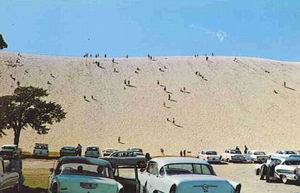
I just returned from a family reunion in northern Wisconsin. It required a trip through the Upper Peninsula of Michigan on Highway 2. Those who have taken that route know that it provides views of lush forest and frequent glimpses of Lake Michigan. It’s a two-lane highway, so passing opportunities are limited.
That means that I spent about 70 miles following a particular car. Among the bumper stickers that it sported was, “Got Sand?” It could have been an ad for a construction company, or -- based upon some of the other stickers -- it could have been an Evangelical prompt of some kind. At any rate, it provided wool for gathering.
Sand has been slang for courage since the mid-1800s. Here are three instances:
• 1867 George Washington Harris, Sut Lovingood Yarns: “I tell yu, he has lots ove san’ in his gizzard; he has the bes’ pluck I ever seed.”
• 1878 Fred Hart, Sazerac Lying Club: “. . . he was always so good-natured and smilin’ like, that a stranger would a thought thar warn’t no sand in him, and he wouldn’t fight nothin’. But he always carried a big bowie in his boot-leg and a dragoon six-shooter in his shirt, and would fight a rattlesnake and give it the fust bite.”
• 1881 New York Times 18 Dec. 4/3 “Sand --To have sand in one’s craw. To be determined and plucky. Equivalent to grit.”
As the last quote indicates, it is allied to the word grit, also slang for courage, fortitude, and stamina, and Chapman’s American Slang assigns a date of 1825. The mention of craw in that New York Times article reveals the origin. A craw is a pouch-like protuberance found in the gullet of many birds. In it, food undergoes partial digestion by rubbing against tiny stones that the bird has ingested.
By the way, if the bird swallows stones that are too large, they stick in its craw, which figuratively describes anything that we can't accept.
Now available from McFarland & Co.: Word Parts Dictionary, 2nd edition
Listen to Mike’s program in real time every Tuesday morning, 9:00 - 10:00 a.m. EST, by going to wtcmradio.com and clicking on Listen Now. There is no archive.
Write to Mike with comments or questions:
wordmallATaol.com
(substitute @ for AT above)
wordmallATaol.com
(substitute @ for AT above)
Check out Mike's program-based books here:
Arbutus Press
http://arbutuspress.com/store_ling.html
or at Amazon.com
Arbutus Press
http://arbutuspress.com/store_ling.html
or at Amazon.com
Visit the Senior Corner at http://seniors.tcnet.org