Monday, December 31, 2007

There’s Jam on the Door Jamb


A jamb is a vertical post or piece that forms one side of a door, a window frame, or a fireplace. It always has one or more partners.

Jamb in Old French meant a leg, and it descended from the Latin gamba, a horse’s hock. (Thus, it is connected to the words gambol and gambit.)

A hock corresponds to the human ankle, but it bends the other way. Science fiction movies sometimes show aliens in the guise of humans, but with grotesquely-jointed legs.
[ reference The Arrival]


The word jamb has had a colorful and varied history.

• On a coat-of-arms, a jamb was a leg.
• In military history, it was armor meant to cover a good portion of a soldier’s leg.
• A jamb was the projecting wing of a building.
• It was a projecting column or pillar in a mine or a quarry.
• Also in mining, jamb signified a bed of clay or stone running across a mineral vein or seam.
• At one time, it was an angular turn or corner in a street or an alleyway.
• And in Nigeria, JAMB is an acronym for Joint Admissions and Matriculation Board.

SIDEBAR: Jamba Juice [on David Letterman]

SIDEBAR: Replacing a split door jamb


Check out Mike's latest book here: http://arbutuspress.com/
or at Amazon.com

Visit the Senior Corner at http://seniors.tcnet.org

wordmallATaol.com
(substitute @ for AT above)

Thursday, December 27, 2007

Coin of the Realm, redux


Tom Phillips from Suttons Bay, Michigan, was looking for information on the phrase, “coin of the realm.” In its literal sense, it meant the legal currency of a given political unit. In its early existence, the word coin had multiple spellings, all deriving from a Latin word meaning corner or wedge [cuneus]. The coin was struck with a wedge-shaped device holding a die that imprinted image and inscription on a blank disc. In time, the word transferred from the die to the money itself. After many centuries, the spelling coin is now reserved for the money, and quoin has been allocated to the corner, angle, or wedge.

Ultimately, the phrase coin of the realm developed into a figurative sense: something valued or used as if it were money in a particular sphere. Here are some diverse examples:

• “Fear, of course, has been the coin of the realm for oppressive and dictatorial governments throughout history. Frighten the citizenry and they’ll practically beg you to take away their freedom.” [Future of Freedom Foundation]
• “Latte is the coin of the realm.” [Joseph Gallivan]
• “Credibility is the coin of the realm.” [Dana Blankenhorn, quoting George Schultz]
• “Scholarly books are the coin of the realm of knowledge.” [Peter Givler]
• “Information is the coin of the realm in the capital.” [Eloise Salholz]
• “On the web, English becomes the coin of the realm.” [WSJ.com]
• "The MBA generally is recognized as the coin of the realm for graduate business education." [Stanley Gabor ]

In other coin-operated phrases, you may end up coining a phrase when you look at the other side of the coin and then pay someone in his own coin.

In his 1821 essay On Familiar Style, British writer William Hazlitt nicely brought the literal and figurative senses together:

“All provincial or bye-phrases come under the same mark of reprobation — all such as the writer transfers to the page from his fireside or a particular coterie, or that he invents for his own sole use and convenience. I conceive that words are like money, not the worse for being common, but that it is the stamp of custom alone that gives them circulation or value. I am fastidious in this respect, and would almost as soon coin the currency of the realm as counterfeit the King's English.”

SIDEBAR: Coin of the Realm


Check out Mike's latest book here: http://arbutuspress.com/
or at Amazon.com

Visit the Senior Corner at http://seniors.tcnet.org

wordmallATaol.com
(substitute @ for AT above)

Monday, December 24, 2007

Happy Holidays, 2007

icon art by Dona Sheehan


When love of us called him to see
If we’d vouchsafe his company,
He left his father’s court, and came
Lightly as a lambent flame,
Leaping upon the hills, to be
The humble King of you and me.

Richard Crashaw
1613 - 1649


Check out Mike's latest book here: http://arbutuspress.com/
or at Amazon.com

Visit the Senior Corner at http://seniors.tcnet.org

wordmallATaol.com
(substitute @ for AT above)

Saturday, December 22, 2007

The Holy Season, part 2


Another Greek root meaning holy is hiero-, from hieros, sacred or holy. Let’s look at some representative samples.

• hierocracy: The rule of priests or religious dignitaries; government by priests or ecclesiastics
• hierodule: A slave (of either sex) dwelling in a temple, and dedicated to the service of a god. [Actually, they tended to be courtesans, a holy office at the time.]
• hierogamy: A sacred marriage.
• hieroglyph: A figure of some object, as a tree, animal, etc., standing for a word. [sacred carving]
• hierogram: A sacred symbol.
• hierograph: A sacred inscription or symbol
• hierography: A description of sacred things; a description of religions.
• hierolatry: Worship of holy beings or saints
• hierology: (1) ‘A discourse on sacred things’ (Webster 1828). Obs. (2) Hieroglyphic lore; the study of Egyptian records. Obs.
• hieromachy: A conflict of ecclesiastics.
• hieromancy: Divination from the observation of objects offered in religious sacrifices, or from sacred things.
• hieromartyr: In the Greek Calendar, a martyr who was in holy orders.
• hieropathic: Consisting in love of the clergy.
• hierophant: An official expounder of sacred mysteries or religious ceremonies, esp. in ancient Greece; an initiating or presiding priest.
• hierophobia: Fear or horror of sacred things or persons.
• hieroscopy: a kind of divination, performed by considering the victim, and observing every thing that occurs during the course of the sacrifice.

SIDEBAR: Egyptian Hieroglyphic Dictionary

SIDEBAR: Hieroglyphic Ensemble [Go to June 26 on that site]


Check out Mike's latest book here: http://arbutuspress.com/
or at Amazon.com

Visit the Senior Corner at http://seniors.tcnet.org

wordmallATaol.com
(substitute @ for AT above)

Thursday, December 20, 2007

The Holy Season, part 1


The church of Hagia Sophia (Holy Wisdom), once the most important church in the Christian Orient.


Perhaps only theologians or word phreaks will care, but a number of words are based on Greek roots that mean holy. Today, let’s focus on hagio-, from the Greek hagios, holy or saintly.

• hagiocracy: A government or sovereignty of persons esteemed holy.
• hagiographer: A sacred writer, especially one of the writers of the Hagiographa [Psalms, Proverbs, Job; Canticles, Ruth, Lamentations, Ecclesiastes, Esther; Daniel, Ezra, Nehemiah, Chronicles]
• hagiography: The writing of the lives of saints; saints' lives as a branch of literature or legend.
• hagiolatry: The worship of saints.
• hagiologist: A writer of hagiology; one versed in the legends of saints.
• hagiology: The literature that treats of the lives and legends of saints; also, by extension, of great men or heroes; a work on the lives and legends of the saints.
• hagiomania: Saintly madness; a mania for sainthood;
• hagioscope: A small opening, cut through a chancel arch or wall, to enable worshippers in an aisle or side chapel to obtain a view of the elevation of the host.
• hagiosidere: [1730] A plate of iron. . .which the Greeks under the dominion of the Turks (being prohibited the use of bells) strike on, with a hammer, to call the people to church.
• hagiotypic: pertaining to types of saints.


Check out Mike's latest book here: http://arbutuspress.com/
or at Amazon.com

Visit the Senior Corner at http://seniors.tcnet.org

wordmallATaol.com
(substitute @ for AT above)

Monday, December 17, 2007

Kicking All Kinds of Butt


Aphrodite: Callipygian Venus


The Greek word for buttocks is pi-upsilon-gamma-eta. The upsilon is usually transliterated as a -y-, so we’d spell the base root as -pyg-. Let’s look at some of the words containing that root and check their meanings.

callipygian: Of, pertaining to, or having well-shaped or finely developed buttocks.
cytopyge: the excretory opening or anus of a unicellular animal.
dasypygal: Having hairy buttocks; rough-bottomed.
platypygous: broad-bottomed (of boats) Zoology Obs. rare having broad buttocks.
pygal: Of or pertaining to the rump or hind quarters of an animal.
pygobranchiate: a group of gastropods having the gills arranged round the anus.
pygopage: a monster consisting of twins united in the region of the buttocks.
steatopygia: A protuberance of the buttocks, due to an abnormal accumulation of fat in and behind the hips and thighs.
uropygial: Situated on, belonging to, the rump. Ornithology

Don’t confuse it with the other Greek root -pyg-, transferred to Latin as -pug-, which relates to fighting (impugn, repugn) and to the fist (pugilism, pugilist, pygmy).

See Shortchanged [September 22, 2006]


Check out Mike's latest book here: http://arbutuspress.com/
or at Amazon.com

Visit the Senior Corner at http://seniors.tcnet.org

wordmallATaol.com
(substitute @ for AT above)

Thursday, December 13, 2007

War of the Words, Trojan Style


In legend, the Trojan War started when Paris abducted Helen, wife of King Menelaus. Referring to Helen, Christopher Marlowe wrote, in The Tragical History of Doctor Faustus,
“Was this the face that launch'd a thousand ships
And burnt the topless towers of Ilium?”

The Trojan War introduced us to a large cast of characters, and some of them have lent their names to words still commonly used.

odyssey
The Odyssey is one of the great epic poems of ancient Greece. It recounts the adventures of Odysseus as he returned home to Ithica after fighting in the Trojan War. It took him an incredible ten years. By extended use, odyssey refers to a long series of wanderings or a long adventurous journey. [See Odyssey of the Mind]

hector
To hector is to act as a bully, to brag, bluster, or domineer. Oddly enough, it is taken from the name Hector, a hero in the Trojan War. For centuries, Hector was regarded as a heroic figure, a valiant warrior with a loyal streak a mile wide. But in 16th century England, his name began to be applied to hoodlums who roamed the streets of London. Shakespeare probably shares much of the blame. He presented Hector as a narcissist in Troilus and Cressida.

achilles heel
An achilles heel is a vulnerable spot--often, the only vulnerability in a person or a plan. Legend has it that Achilles’ goddess mother, Thetis, tried to make her baby immortal by dipping him in the River Styx. She held him by the heel so she could retrieve him, and that remained his only vulnerability. Sure enough, he died when an arrow [some say a spear] hit him in the heel. But before that, he killed Hector during the Trojan War.

trojan horse
Trojan is the adjective referring to Troy, and a trojan horse is something that destroys from within--something insinuated to bring down an enemy. In computer terms, it is software surreptiously inserted into a computer. It appears to be doing something legitimate, but it actually gives the perpetrator control of the invaded computer. Historically, the name refers to a hollow wooden horse, ostensibly abandoned by the fleeing Greek fleet, in which Greek forces, including Odysseus, hid themselves in order to enter Troy.

ADDENDUM: My son Michael reminds me that I left one out--Stentor. Stentor was a Greek warrior in the Trojan war, “whose voice was as powerful as fifty voices of other men.” The word stentorian thus means very loud, powerful, and far-reaching in sound, as a person with a stentorian voice.

SIDEBAR: The Trojan Band

SIDEBAR: McAfee Threat Center

Check out Mike's latest book here: http://arbutuspress.com/
or at Amazon.com

Visit the Senior Corner at http://seniors.tcnet.org

wordmallATaol.com
(substitute @ for AT above)

Monday, December 10, 2007

Steep


The word steep may have arisen from a Scandinavian word describing the process of soaking barley in order to make a malt.

As a noun, it means the soaking process, the liquid used in maceration, and the wild midday plunge taken by a stag in hot weather. Who would have known?

The adjective has meant elevated or lofty, having a high voice, brilliant (such as the eyes or stars), perpendicular and precipitous, arduous and difficult, violent or extreme, and excessive or extravagant. It’s all over the landscape.

The verb means to soak in water or some other liquid, to bathe or envelop as in a mist, to soak a weapon in blood, to deaden the senses, and to place in a sloping condition.

By the way, did you know that 8 1/2 bushels of good dry barley will, after forty-eight hours steep, swell to exactly 100 bushels? So says the 1896 edition of Encyclopedia Britannica. Better check that leaky storage shed.

The word steeple--a lofty tower forming part of a church, temple, or other public edifice (often serving to contain the bells)--is obviously connected. These days, a steeplechase is a man-made course supplied with artificial fences, water-jumps, and other obstacles to test horse and rider. Originally, racers picked out a distant church steeple and raced towards it, dealing with whatever obstacles intervened: ditch, fence, hedge, etc. The first one to reach the church was the winner.

SIDEBAR: The Steep Canyon Rangers

SIDEBAR: Steep cliffs on Mars

Check out Mike's latest book here: http://arbutuspress.com/
or at Amazon.com

Visit the Senior Corner at http://seniors.tcnet.org

wordmallATaol.com
(substitute @ for AT above)

Thursday, December 06, 2007

The Shadow Knows


Shade and shadow are linguistic brothers, both found in Old English and with relatives in the Teutonic language groups. Both express comparative darkness -- the lack of complete illumination. Later, in a figurative application, they came to mean spirits of the underworld.

Thanks to Latin and Greek roots, there are many words in English that lurk in the shadows. Here are a few.
• adumbrate: to overshadow, shade, obscure [L. umbra, shadow]
• macroscian: having a long shadow [Gr. skia, shadow]
• penumbra: a partially shaded area [L. umbra]
• sciamachy: fighting with shadows [Gr. skia]
• sciatheric: pertaining to a sundial [Gr. skia]
• sciomancy: divination by communication with the shades of the dead. [Gr. skia]
• sciurine: belonging to the squirrel family [literally, “shadow tail”]
• skiascope: instrument that measures refraction in the eye [Gr. skia]
• umbrage: displeasure, annoyance, offence, resentment [L. umbra]
• umbrella: portable shelter or protection [L. umbra]

Interestingly, in the 17th and 18th centuries, there seems to have been a preoccupation with fabled people in distant lands based on their shadow-casting characteristics.
• Amphisians: a name given to inhabitants of the torrid zone, whose shadows at one time of the year fall northward, at another southward.
• Antiscii: those who live on the same meridian, but on the opposite side of the equator, so that their shadows at noon fall in opposite directions.
• Ascians: inhabitants of the torrid zone, who twice a year have the sun directly overhead at noon, and then cast no shadows.
• Heteroscian: a name applied to the people of the two temperate zones in reference to the fact that, in the two zones, noon-shadows always fall in opposite directions.
• Macroscian: a person whose shadow is long, specifically an inhabitant of the polar regions.
• Periscii: the inhabitants of the polar regions, so called from the fact that their shadows revolve around them as the sun moves round.
• Sciapodes: a fabulous people of Libya “with immense feet which they used as sunshades” (Liddell & Scott). Move over, Emmet Kelly.

SIDEBAR: The Shadows

SIDEBAR: The sound of the Shadows

Check out Mike's latest book here: http://arbutuspress.com/
or at Amazon.com

Visit the Senior Corner at http://seniors.tcnet.org

wordmallATaol.com
(substitute @ for AT above)

Charity: freerice.com

Monday, December 03, 2007

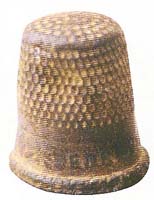
Thimble


A thimble is a bell-shaped sheath worn on the thumb to push the needle through resisting material while sewing. It is believed that the earliest thimbles were made of leather, although the oldest surviving thimbles are made of bronze or other metal. In modern times, they have been made of any material accessible to humans.

The word thimble is close in appearance to the word thumb, and that’s no accident. Thimble tracks back to the Old English thuma, thumb. The -le ending sometimes signifies an instrument or tool, as in handle and paddle.

In construction, a chimney thimble is a sleeve embedded in the chimney wall designed to accept the flue connector from an appliance.

Collectors of thimbles call themselves digitabulists, from the Latin digitus, a finger. [Pollicist, from the Latin word for thumb, might have been more appropriate.] A couple of other thumb words are pollical and pollicar, pertaining to the thumb.

SIDEBAR: The Thimbles

SIDEBAR: Thimble Collectors International


Check out Mike's latest book here: http://arbutuspress.com/
or at Amazon.com

Visit the Senior Corner at http://seniors.tcnet.org

wordmallATaol.com
(substitute @ for AT above)

Thursday, November 29, 2007

Tip A Canoe


Where did “don’t rock the boat” get started? Gus/Grayling, MI

It’s much easier to say what it means. Most of us have ridden in canoes or rowboats with a rambunctious youngster or twitchy passenger, so we recognize it as a salutary warning not to mess with the equilibrium. It’s pretty easy to upset the balance of a small craft, thus exposing oneself to the danger of tipping over.

This is such a universal and ancient experience that I’d be surprised if someone were able to cite the very first literal use of the term. Metaphorically, it means to let things be, to avoid upsetting routine ways, to honor the status quo. It is akin to another nautical warning, don’t make waves.

The Online Etymology Dictionary says that “to rock the boat” is attested from 1931, but it doesn’t give an example. The Oxford English Dictionary provides this from the same year: Frederick Lewis Allen, Only Yesterday: an informal history of the nineteen-twenties vi. 156. “Unfortunate publicity had a tendency to rock the boat.”

The idiom seems to reflect a cautious streak in human behavior, so I suppose we could pair it with don’t change horses at midstream, along with let sleeping dogs lie. Tie them all together and we have don’t rock the dog to sleep at midstream. Sound advice, dawg.

SIDEBAR: Rock the Boat (The Hues Corporation)

SIDEBAR: Don’t Rock the Boat (Bob Marley)

SIDEBAR: Guys and Dolls: Sit Down, You’re Rocking the Boat


Check out Mike's latest book here: http://arbutuspress.com/
or at Amazon.com

Visit the Senior Corner at http://seniors.tcnet.org

wordmallATaol.com
(substitute @ for AT above)

Monday, November 26, 2007

Day by Day


The Old English word for day (daegh) probably tracks back to a Sanskrit word meaning “the burning time,” a reference to the hot sun. [See ALL IN A DAY’S WORK, September 13, 2007]

In this entry, I’d like to focus on a few of the words that contain the word day while expressing it in covert fashion. The point? Love of words, plain and simple.

adjourn: to put off until another day [L. ad, to + diurnus, day]
biduous: lasting for two days [L. bi-, two + dies, day.]
circadian: designating physiological activity which occurs approximately every twenty-four hours, or the rhythm of such activity. [L. circa, about + dies, day]
daisy: the familiar flower [OE dæges éage day's eye, eye of day]
Decameron: Boccaccio’s tales, allegedly told in ten days [Gr. deka, ten + hemera, day]
dial (sundial): an instrument serving to tell the hour of the day by means of the sun's shadow upon a graduated surface [L. dialis, daily]
diary: daily record of events [L. dies, day]
diurnal: occupying one day [L. diurnalis, daily]
du jour: that which is chosen or allocated for a particular day [Fr. du jour, of the day] NOTE: therefore, never ask for the soup du jour of the day.
ephemeral: fleeting; temporary [Gr. epi, for + hemera, day]
hemeralopia: a visual defect in which the eyes see indistinctly, or not at all, by daylight, but tolerably well by night or artificial light [Gr. hemera, day + alaos, blind + ops, eye]
hemerine: belonging to a day, esp. a fever [Gr. hemera, day]
hodiernal: pertaining to the present day [L. hodie, today]
journal: a daily record [Fr. jour, day]
journey: the distance travelled in a day or a specified number of days [Fr. journée, a day’s travel] NOTE: in the Middle Ages, approximately 20 miles constituted a day’s journey.
meridian: relating to noon [L. medius, middle + dies, day]
pridian: relating to the previous day [L. pri, before + dies, day]
procrastinate: put off until the day after [L. pro, for + cras, tomorrow]
quotidian: pertaining to every day [L. quotidie, every day]
sojourn: a temporary stay in a place [Fr. jour, day]
ultradian: designating cycles of physiological activity which recur with a period shorter than one day but longer than one hour [L. ultra, beyond + dies, day]

SIDEBAR: Day by Day (me faz bem) by Luca Mundaca

SIDEBAR: Chastity Bono: Day by Day (Ceremony)


Check out Mike's latest book here: http://arbutuspress.com/
or at Amazon.com

Visit the Senior Corner at http://seniors.tcnet.org

wordmallATaol.com
(substitute @ for AT above)

Saturday, November 24, 2007

Fence


I was watching an old crime movie last night, and one of the characters said, “I gotta fence some goods.” I know it means to sell some loot, but why fence? Lois/Traverse City, MI

The verb fence is usually connected with protection and disguise, thus reinforcing the idea of ill-gotten goods being concealed. Martin Mark-all, beadle of Bridewell, his defence and answere to the (Dekker's) belman of London by S. R. (also attributed to S. Rid) 1610: “To fence property, to sell anything that is stolne.”

The noun fence, meaning a receiver of stolen goods, is recorded in Memoirs of John Hall, 4th edition, 1708: “Fence, one that buys stoln goods.” It seems to be connected to a literal fence, a barrier to hide and protect things. Ulimately, it is connected to the word defence.

SIDEBAR: Fence music--Australian fences played by Jon Rose

Check out Mike's latest book here: http://arbutuspress.com/
or at Amazon.com

Visit the Senior Corner at http://seniors.tcnet.org

wordmallATaol.com
(substitute @ for AT above)

Sunday, November 11, 2007

Oh, Fell Felon!


A felon is someone who has committed a felony, a serious crime with serious consequences. The class includes acts such as murder, rape, burglary, or treason. In early English law, it was cause for losing one’s fee--the land granted to a vassal by his lord. Punishment might additionally include an amputated limb or even execution.

While there is some uncertainty, the OED seems to lean towards an Old French/Latin word meaning “someone full of bitterness, venom, or gall.” It would then have a connection to the adjective fell--fierce, savage, cruel, ruthless:

"Wide wounds emongst them many a one he [Sidney] made,
Now with his sharp borespeare, now with his blade...
So as he rag'd emongst that beastly rout,
A cruell beast of most accursed brood:
Vpon him turnd (despeyre makes cowards stout)
And with fell tooth accustomed to blood,
Launched his thigh with so mischieuous might,
That it both bone and muscles ryued quight".
Spenser’s Astrophel (1595)

The word fell survives in the popular saying “one fell swoop,” originally a grim reference to a hawk or other bird of prey swooping down on its victim. Less menacing in our day, it now means “all at once.”

Felon as an adjective has generally referred to negative qualities:
• terrible, wicked, and base (1300)
• murderous (1320)
• angry or sullen (1374)
• stolen (1631)

On the other hand, it mysteriously acquired a positive connotation at times, possibly because some cruel qualities were an asset for warriors:
• brave, courageous, and sturdy (1375)
• tremendous, huge, or terribly great (1450)

Felon , n. 2, is connected through the Latin word for gall, but it refers to an abscess, an inflamed sore, a boil, or a suppuration.

SIDEBAR: Felony, a Swiss Melodic Metal Band


__________________________________________________________

NOTE: on vacation until November 26, 2007
__________________________________________________________


Check out Mike's latest book here: http://arbutuspress.com/
or at Amazon.com

Visit the Senior Corner at http://seniors.tcnet.org

wordmallATaol.com
(substitute @ for AT above)

Thursday, November 08, 2007

Love Me Tender, Tenterhook


Barry/Suttons Bay, MI: I overheard someone say that she was on tender hooks while waiting to see if her bid on a house was going to be accepted, but I’m not really sure what she meant. Any help?


First of all, if you looked for that phrase, you probably found nothing. What she said (or should have said) was that she was on tenterhooks. It’s easy to mishear D’s and T’s because they are formed in the same area of the mouth, with the tongue touching the teeth.

This takes us back to 15th century cloth makers. When cloth was milled and dyed, it was stretched on a wooden framework so that it would not shrink or lose shape as it dried. The wooden frame was called a tenter, perhaps deriving from the Latin tendere, to stretch.

The tenterhooks were the close-set hooks or nails set into the wooden framework to hold the cloth; they suspended the cloth in a uniform fashion. Eventually, tenterhooks acquired the figurative meaning of something causing excruciating suspense.

The cliché to be on tenterhooks was set in place by British novelist Tobias Smollett in his hilarious Roderick Random [1748]: “I left him upon the tenter-hooks of impatient uncertainty.”

I suppose that tender hook can be seen as a eggcorn*, since it would imply that even though you were metaphorically suspended, it wasn’t something that would cause you great harm; the hooks are tender. But tenterhooks is the correct word choice.

*[Geoffrey Pullum, The Language Log ]


Check out Mike's latest book here: http://arbutuspress.com/
or at Amazon.com

Visit the Senior Corner at http://seniors.tcnet.org

wordmallATaol.com
(substitute @ for AT above)

Monday, November 05, 2007

Smack Dab in the Middle


David/Beulah, MI: What does smack dab in the middle actually mean, and where did it come from?

In essence, the phrase means “slapped precisely in the center.” According to the Oxford English Dictionary, smack-dab showed up in print in 1892: “He hit him smack dab in the mouth” [Dialect Notes I, 232].

The first element, smack, is used as an adverb. It is defined as “with, or as with, a smack; suddenly and violently; slap.” It appears in 1782 in Cowper’s John Gilpin: “Smack went the whip, round went the wheels.”

The second element, dab, means “with a dab or sudden contact.” Robert Armin’s Nest of Ninnies uses it in this sense in 1608: “He dropt downe..as heauy as if a leaden plummet... had fallen on the earth dab.”

A variation is slap-dab: “He was goin' that fas' he run slap-dab agin me afo' he seed me” [1886, Turf, Field & Farm XLII. 174/3].

Slap-bang is close, but it meant immediately rather than centered: “Slap-bang shop: a petty cook's shop where there is no credit given, but what is had must be paid down with the ready slap-bang, i.e. immediately” [1785, Grose’s Dictionary of the Vulgar Tongue].

SIDEBAR: jazz version performance

Check out Mike's latest book here: http://arbutuspress.com/
or at Amazon.com

Visit the Senior Corner at http://seniors.tcnet.org

wordmallATaol.com

[AT = @]

Thursday, November 01, 2007

Beyond the Pale

Vlad the Impaler


Thad: Harry Reid's letter about Rush Limbaugh described Rush's statements as "beyond the pale." What's that supposed to mean and where did it come from?

Beyond the pale means outside the limits of acceptable behaviour, something that is seriously inappropriate or improper.

Pales were stakes or posts used to construct a fence or enclosing barrier of any material [Latin palum]. By extension, a pale was a district or territory within determined bounds, or subject to a particular jurisdiction; it was a safe, civilized haven--perhaps the boundaries of church property or of a shire’s footprint. Outside that pale lurked danger and potential lawlessness beyond anyone’s jurisdiction.

There were a few historically famous Pales, but they don’t seem to have been necessary for this phrase to arise.

In heraldry, a pale was a vertical band in the middle of a shield. Other meanings for the noun pale included

• pallor
• a small plug in a barrel
• a cheese-scoop
• a baker’s shovel
• a decorative stripe on clothing
• light-colored ale
• chaff

The adjective pale came from the Latin word pallidum, pale.


SIDEBAR: Beyond the Pale, an Irish music band

Check out Mike's latest book here: http://arbutuspress.com/
or at Amazon.com

Visit the Senior Corner at http://seniors.tcnet.org

wordmallATaol.com
(substitute @ for AT above)

Monday, October 29, 2007

My Mere Fell Into the Mere While Holding a Mere


For some reason, I enjoy finding words that come from entirely unrelated origins, but end up with identical spelling through accidents of history or linguistic quirkiness. Pedology is a prime example:

• Pedology [Greek pedon, soil] is the scientific study of soil composition.
• Pedology [Greek paid-, child] is the study of physical and mental development in children.

Several unrelated words, in their journey over the centuries, ended up with the spelling m-e-r-e. I’m not reaching for a point here; this doesn’t really go anywhere. If you love words, the thrill of jarring juxtaposition will be enough.

mere [In various Germanic and Scandinavian languages, the sea]

• a drainage channel filled with water
• a lake, pond, or pool
• an arm of the sea; an inlet
• a marsh or fen
• a mermaid

mere [Latin murus, wall]

• a boundary or border
• a strip of uncultivated land
• a linear measurement along a vein of ore
• to delineate boundaries (v)

mere [French mere, mother]

• a mother
• the elder of two women of the same name, especially a mother as distinct from her daughter or daughters

mere [Greek moros, mighty]

• renowned, famous, illustrious; beautiful, splendid, noble, excellent
• notorious, infamous

mere [Latin merus, undiluted, pure, unmixed]

• pure, unmixed, unalloyed; undiluted, unadulterated
• of wine: not mixed with water
• of a people or their language: pure, unmixed
• to purify or refine (v)
• insignificant, ordinary; inadequate, feeble.

mere [Maori mere, a club]

• a short flat Maori war club of hard wood, whalebone, or greenstone


SIDEBAR: mere, NYC band

Check out Mike's latest book here: http://arbutuspress.com/
or at Amazon.com

Visit the Senior Corner at http://seniors.tcnet.org

wordmallATaol.com
(substitute @ for AT above)


Thursday, October 25, 2007

All I Have To Do Is Glean, Glean, Glean


The Gleaners
François Millet (1857)

Ron Jolly showed me a book with the word gleanings in its title and asked where the word came from.

Used as a metaphorical term, gleaning refers to gathering odds and ends of information bit by bit and placing them in one written piece. The word gleanings shows up in the title of many books and pamphlets, a surprising number of them about local history or about religious thoughts. The word tracks back to a verb found both in Old French (glener) and Late Latin (glenare).

To glean was to wander through fields that had already been harvested in order to gather the scraps left behind by the reapers. The most famous gleaner was Ruth, who benefited from the generosity of Boaz.

Not only was leaving material for the poor to glean an act of kindness, it was seen as a religious obligation:

Leviticus 19:9–10. And when ye reap the harvest of your land, thou shalt not wholly reap the corner of thy field, neither shalt thou gather the gleaning of thy harvest. And thou shalt not glean thy vineyard, neither shalt thou gather the fallen fruit of thy vineyard; thou shalt leave them for the poor and for the stranger: I am the Lord your God.

Leviticus 23:22. And when ye reap the harvest of your land, thou shalt not wholly reap the corner of thy field, neither shalt thou gather the gleaning of thy harvest; thou shalt leave them for the poor, and for the stranger: I am the Lord your God.


SIDEBAR: Food Recovery and Gleaning Initiative:
A Citizen’s Guide to Food Recovery

SIDEBAR: movie -- The Gleaners and I

Check out Mike's latest book here: http://arbutuspress.com/
or at Amazon.com

Visit the Senior Corner at http://seniors.tcnet.org

wordmallATaol.com
(substitute @ for AT above)

Monday, October 22, 2007

An Armistice in the Interstices


A word buff reminded me recently of something that I had long forgotten: that the -stice segment of words such as armistice or solstice share the base meaning “to stop.”

It forced me to run for my dictionary, because my immediate assumption was that the -stice ending was simply a reflection of the Latin ending -itia, as in amicitia (friendship) or justitia (justice).

But it turns out that the form derives from the Latin verb sistere, which gave rise to stitium, a stopping. So the range of meaning involved here includes stop, stand, and cease. Related forms come from the Latin verb stare, to stand, which gave us station, stationary, and status.

Getting back to the stop suffix, we find a few examples:

• armistice: a cessation from arms for a time; a short truce. [arma = weapons]
• interstice: a space standing between things or parts. [inter = between]
• justitium: a legal vacation. The legal system stops for a while. [jus = law]
• solstice: two times a year (June 21 and December 22), when it is farthest from the equator, the sun seems to stop in its tracks. [sol = sun]
• lunistice: the point at which the moon is farthest north or farthest south and seems to stop for a while. [luna = moon]

No sign of januastice, a doorstop.


SIDEBAR: belly dance by Solstice

Check out Mike's latest book here: http://arbutuspress.com/
or at Amazon.com

Visit the Senior Corner at http://seniors.tcnet.org

wordmallATaol.com
(substitute @ for AT above)

Thursday, October 18, 2007

Aye, Aye, Sir


David from Gaylord asked about the origin of the naval term “aye, aye, Sir.”

“Aye, aye, Sir” is the proper response for a sailor to give to a superior. As Charles from Atwood confirmed in his call-in, the double aye is meant to convey that the order has been both received and understood.

There is some confusion over the origin of the term, however, probably because there are two ayes. One of them meant forever or always. The other meant yes. There is some speculation that the latter came from the former, the transition being something like always/by all means/with certainty/yes. [Oxford English Dictionary]

But militating against this is the fact that the first written instances spell that version of yes as I:

• “If you say I, syr, we will not say no.” [1576, Tyde Taryeth no Man]
• “Nothing but No and I, and I and No.” [1594, Drayton, Idea, 57]

At various times it was also spelled ey, ai, ay, and hye. So the suggestion found on some web sites that aye is an initialism for “at your [service] ever” lacks any foundation.

Aside from its nautical use, it is the formal word used to signal a yes vote in the British House of Commons. And, to get completely off the track, aye-aye (as listener Susan of Copemish shared with me) is the name of a nocturnal tree-dwelling primate found only in Madagascar. The best guess for the animal’s name is that it came from some now defunct language native to Madagascar and may have been onomatopoeic in origin.

At any rate, it had no connection to sailors or to assent.

SIDEBAR: the aye-aye

Check out Mike's latest book here: http://arbutuspress.com/
or at Amazon.com

Visit the Senior Corner at http://seniors.tcnet.org

wordmallATaol.com
(substitute @ for AT above)

Monday, October 15, 2007

Caterwaul


Doug from Traverse City asked about the origin of the word caterwaul.

This word has two components. The first part, cater-, obviously contains the word cat. While there seems to be some uncertainty, the German word kater, a tomcat, probably had some influence. The word shows up in a colorful idiom: einen kater haben, to have a hangover.

The second component is more traceable. It comes from the verb wrawen, to wail or howl. The word was used in reference to cats in heat, and it may simply have been onomatopoeia, an imitation of the sound itself. Other language groupings such as Danish, Swedish, Norwegian, and Swiss had similar words referring to cats in heat, and the word also applied to stallions in heat and to a rowdy, poorly behaved man. No mention of heat there.

So the earliest use of the word was to describe the noise made by cats at rutting time. Later, it came to mean any hideous noise or a quarrel in feline fashion. It also meant lascivious or lecherous.

No connection, but there are a few more curious words, some of them obsolete, that convey the meaning to wail or howl.

• ejulation: wailing, lamentation.
• ululation: a howl or wail; a cry of lamentation.
• vagitus: a cry or wail, especially that of a new-born child.
• Then there’s a word that sounds like it comes from Saturday Night Live: wailster, a female wailer. It’s the Wailster!

SIDEBAR: Caterwaul, the band

SIDEBAR: Trail of Dead--Caterwaul

SIDEBAR: Cat sound


Check out Mike's latest book here: http://arbutuspress.com/
or at Amazon.com

Visit the Senior Corner at http://seniors.tcnet.org

wordmallATaol.com
(substitute @ for AT above)

Friday, October 12, 2007

Nip It in the Butt


I alluded to eggcorns in the last entry, and wouldn't you know it, I came across another one within hours:

“The Michigan House and Senate must nip the budget crisis in the butt, not pass a temporary measure that only defers the problem.”

I used to have a feisty Westie named McDuff. My brother used to tease the dog when McDuff was a puppy, so there was no love lost between them. In fact, we used to encourage McDuff’s frequent nipping attacks, everyone hollering, “Bite him on the butt!”

I bring this up only because it gives some insight into why someone might hear nip it in the bud and think that it alluded to a terrier snapping at someone’s glutes. The essential problem is that it then refers to action: an attack on the part of the animal and a retreat on the part of the victim.

In contrast, nip it in the bud actually means to stop something before it becomes serious or significant. It was originally a gardening term, and it refers to removing or severing a bud by pinching or snipping it off. Too many buds on the same stalk lead to inferior flowers or plants, so this is a form of botanical birth control.

Oh, oh . . . I hear a scary noise outside my window coming from the garden. I’m starting to shutter.

SIDEBAR: flower and plant care

Check out Mike's latest book here: http://arbutuspress.com/
or at Amazon.com

Visit the Senior Corner at http://seniors.tcnet.org

wordmallATaol.com
(substitute @ for AT above)

Monday, October 08, 2007

Handsome Cab, Ugly Driver


My son shared this headline with me last week:

Handsome cab horse killed in Central Park accident

This was a headline that appeared recently on several New York web sites and in a neighborhood newspaper. It falls into the category known as eggcorns--incorrect substitutions that result from words not clearly heard or mistaken for others. [See The Eggcorn Database at http://eggcorns.lascribe.net/ ]

It actually should have read Hansom cab, of course. Hansom was the family name of architect Joseph Hansom of Leicestershire, England, who in 1834 patented a vehicle with some of the earlier features of this type of cab. (He also designed the square at Ratcliffe College, a boarding and day school in that town, and what is now the New Walk Museum, originally built as a school.) A Hansom cab was a low-hung two-wheeled cabriolet holding two persons inside, the driver on an elevated seat behind, and the reins running over the roof. It had a low center of gravity for safety in cornering.

The newspaper story went on to give some details of the accident.

A Central Park carriage horse was killed Friday afternoon in what is being described as a “freak accident” along Central Park South. Police say it started when a 12-year-old mare named "Smoothie" was spooked by someone playing a snare drum after four o' clock Friday afternoon. The horse then ran into the street with the carriage still attached and struck a tree.

But it gets even better:

"Nobody should be allowed to set up a snare drum set or any kind of drum set without a parade permit right near to the horse's ears,” said a witness.

So if you wish to beat your drum in Central Park, you had better hold a document near the horse’s head.

This brings us into dangling modifier territory, of course, joining the ranks of the following dubious constructions:

• Pressing the button, the elevator went down to the basement.
• Driving like a maniac, the deer was hit and killed.
• Left alone in the house, the lightning scared the child.
• With his tail held high, my father led his prize bull around the arena.
• We saw firefighters fighting fires that suffered heat exhaustion.
• I saw the dead dog driving down the interstate.
• By the age of ten, both of Dana's parents had died.
• She handed out brownies to the children stored in tupperware.

By the way, handsome cab is not an entirely isolated mistake. When you key “images” on Google, you get at least 15 pictures of a handsome cab; search the web, and you receive 120 hits.

And some Carriage Park Condominiums in Melbourne, Florida, have addresses on Handsome Lane.

My, that’s a good looking vehicle.

SIDEBAR: horse & cab sounds

Check out Mike's latest book here: http://arbutuspress.com/
or at Amazon.com

Visit the Senior Corner at http://seniors.tcnet.org

wordmallATaol.com
(substitute @ for AT above)

Thursday, October 04, 2007

Under the Old Oak Tree


To corroborate is to confirm what someone else has asserted. You strengthen his or her statement, argument, or stance by shoring it up with your own. In the 16th century, corroborate simply meant to strengthen something material. Its source was the Latin word roborare, to make strong.

An early cousin was roborant, an invigorating or strengthening medicine. So was roboration, a strengthening, support, or invigoration. The old forms roborean and roboreous open another window into the roots of the word: both mean pertaining to oak.
In Latin, robus was the name for an oak tree.

The variant root -robur- shows up in a few words, mostly obsolete. Roburite is a flameless explosive of very high power. Roburnean means of or belonging to oak. Robur-oak is a very hard-wooded variety of oak.

All of this explains our word robust, which is used for everything from a healthy body to a strong cup of coffee.

SIDEBAR: facts about oak trees


Check out Mike's latest book here: http://arbutuspress.com/
or at Amazon.com

Visit the Senior Corner at http://seniors.tcnet.org

wordmallATaol.com
(substitute @ for AT above)

Monday, October 01, 2007

Dapper


The word dapper has a slightly old-fashioned feel to it. It means neatly dressed, trim, lively and alert, very stylish in dress or appearance.

In recent times, it has not been as complimentary as it once was. It has taken on undertones of fussiness, dandyism, or petty attention to fashion. Still, it often is used appreciatively and positively.

For a word that denotes elegance, it had strange beginnings. It started in the Low Germanic language group, perhaps in Flemish or Dutch regions. It meant powerful, strong, and stout. These developed into persevering, brave, and undaunted.

Ultimately, the neatly accoutered undaunted knight morphed into the dauntless well-dressed road warrior.

SIDEBAR: Dapper: the quest to unlock web data legally

Check out Mike's latest book here: http://arbutuspress.com/
or at Amazon.com

Visit the Senior Corner at http://seniors.tcnet.org

wordmallATaol.com
(substitute @ for AT above)

Thursday, September 27, 2007

Trinket


TRINKET

Great Expectations, Charles Dickens:
“. . .her watch and chain were not put on, and some lace for her bosom lay with those trinkets, and with her handkerchief, and gloves, and some flowers. . . .”

Vanity Fair, William Makepeace Thackeray:
“All his suspicions, which he had been trying to banish, returned upon him. She could not even go out and sell her trinkets to free him.”

Mansfield Park, Jane Austen:
“She was answered by having a small trinket-box placed before her, and being requested to choose from among several gold chains and necklaces.”

There are at least six meanings for the word trinket, many of them totally unrelated to each other. The first noun meaning listed below is the one we frequently use, and it is operative in the opening quotations.

trinket n.
• A small ornament or fancy article, usually an article of jewelry for personal adornment.
• an item of little value.
• A small drinking vessel; a cup, mug.
• A kind of sail; esp. the triangular sail before the mast, in a lateen-rigged vessel.
• A small or narrow channel or watercourse.

trinket v.
• To have clandestine communications or underhand dealings with; to intrigue with; to act in an underhand way, prevaricate.
• To deck out with trinkets.

The origin of our current sense is uncertain. OED suggests there is a slender chance that it may be related to the phrase “to trick out,” meaning to decorate with baubles or trifling ornaments.

Two related words are trinketry (articles of personal decoration or of ornament viewed as trinkets or toys), and trinkety (of little importance; trivial, paltry).

Trinket and trinketing in the sense “items of little value” are enjoying a revival thanks to computer games.

SIDEBAR: World of Warcraft Terminology Guide

Check out Mike's latest book here: http://arbutuspress.com/
or at Amazon.com

Visit the Senior Corner at http://seniors.tcnet.org

wordmallATaol.com
(substitute @ for AT above)

ACRONYMS AND INITIALISMS: the long and the short of it

Listen to the  podcast version of the article here. To sa ve time, many industries and organizations abbreviate their names by extracting th...