Please click the Follow button below to get updates from The Professor.

Follow this blog

Saturday, June 15, 2013

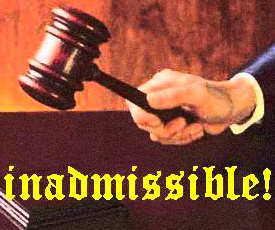
Is Inadmissible Unacceptable?


Sometimes a word strikes us as slightly out of focus, a bit fuzzy and inappropriate. I encountered such a word yesterday while watching CNN. Wesley Clark was being interviewed, and the topic was Syria crossing President Obama’s red line, thus finally triggering direct aid to the rebels. The General said, “Using chemical weapons is totally inadmissible.”

Perhaps it’s just my dialect, but I found his use of “inadmissible” mildly jarring. I associate inadmissible with trials and courts of law. Evidence may be inadmissible because it was obtained without a warrant, and testimony may be inadmissible because it is based on hearsay. But in my neighborhood, using WMD’s is unacceptable, not inadmissible.

When defining inadmissible, most online dictionaries make a reference to court, evidence, or testimony, thereby confirming my assessment. I found only one that gave a secondary definition: “not to be allowed or tolerated.” I found it on the Oxford Dictionaries site.

Our brethren to the north have their own take on the word inadmissible. Some people are not allowed to enter Canada. They are known as “inadmissible” under Canada’s Immigration and Refugee Protection Act (IRPA). You might not be admitted for any of the following reasons: security considerations, human or international rights violations, criminality, contagious diseases, financial reasons, misrepresentation, or having an inadmissible family member.

I did find one other site that used inadmissible as a synonym for unacceptable—The Voice of Russia site. It contained this quote: "We are extremely concerned with media reports [about the capture of sarin gas by Turkish forces]. Russia believes that the use of any chemical weapons is absolutely inadmissible,” Russian Foreign Ministry spokesman Alexander Lukashevich is quoted by a Russian TV channel as saying on Thursday.

So, whether it’s actually off base or just foreign to my ear, the word inadmissible is out there at least occasionally as a synonym for unacceptable.

Available from McFarland & Co.: Word Parts Dictionary, 2nd edition

Nook edition

Check out Mike's program-based books here:
 Amazon.com

Listen to Mike’s program in real time every Tuesday morning, 9:10 - 10:00 a.m. EST, by going to wtcmradio.com and clicking on Listen Now. You’ll also find about a month’s worth of podcasts there under The Ron Jolly Show.


Wednesday, June 12, 2013

Wad


As a Michigan Commissioner of Services to the Aging, it was my privilege, on behalf of the Commission, to designate the Village of Bellaire as a Community for a Lifetime (i.e., elder-friendly). In explaining the significance of the award, Dan Dozema, field representative of the Michigan Office of Services to the Aging, referred to the “wads of paper” that were required to complete the required survey.

A wad originally meant a bundle of hay, straw, or vegetables made at the time of reaping. It expanded to mean a heap or a sheath of any vegetative matter. From there, it turned into a small bundle of a soft, flexible material for use as a plug or a pad. In America, it was used to describe something rolled up tightly, as a roll of bank notes. To blow your wad (the non-obscene version) meant to lose all your money, probably at gambling.

A wad was also material composed of matted fibers of silk, raw cotton, and so on. A plug or tampon of cloth, felt, or cardboard was used to hold powder and shot in place when loading a gun. This led to “shooting one’s wad”—firing a gun—which then expanded to mean doing everything possible, giving one’s all.

Available from McFarland & Co.: Word Parts Dictionary, 2nd edition

Nook edition

Check out Mike's program-based books here:
 Amazon.com

Listen to Mike’s program in real time every Tuesday morning, 9:10 - 10:00 a.m. EST, by going to wtcmradio.com and clicking on Listen Now. You’ll also find about a month’s worth of podcasts there under The Ron Jolly Show.


Friday, June 07, 2013

Imminently Eminent


Tim from Old Mission Peninsula commented that imminent and eminent seem to be increasingly confused, even on national newscasts. While they do sound alike when said aloud, there is a real distinction.

Imminent means that something is about to happen. An event is impending, looming, just around the corner.  For some reason—probably its Latin progenitor—negative things are more likely to be called imminent than positive happenings. Storms, invasions, and market crashes are imminent. Birthdays, weddings, and awards are approaching. The Latin source was imminere, to project or overhang in a threatening way, like a rock slide waiting to happen.
           
Eminent came from the Latin eminere, to project. It is a close cousin, but in this case, prominence and height were emphasized, not danger. Exalted, dignified, distinguished, and noteworthy would be synonyms.

We may add immanent to the mix. It means indwelling or inherent, and it is rooted in the Latin immanere, to dwell or remain within. Its antonym would be transcendent, mirroring the matching pair internal and external.

Available from McFarland & Co.: Word Parts Dictionary, 2nd edition

Nook edition

Check out Mike's program-based books here:
 Amazon.com

Listen to Mike’s program in real time every Tuesday morning, 9:10 - 10:00 a.m. EST, by going to wtcmradio.com and clicking on Listen Now. You’ll also find about a month’s worth of podcasts there under The Ron Jolly Show.


Sunday, June 02, 2013

One week left to vote!

The Top 100 Language Lovers 2013 competition hosted by the bab.la language portal and the Lexiophiles language blog is under way, and my blog WORDMALL has been nominated.

The voting period extends from May 22nd to June 9th, and I would appreciate your vote. Entries are arranged alphabetically, so look for this blog towards the end of the list.

http://en.bab.la/news/top-100-language-professional-blogs-2013-voting


Available from McFarland & Co.: Word Parts Dictionary, 2nd edition

Nook edition

Check out Mike's program-based books here:
 Amazon.com

Listen to Mike’s program in real time every Tuesday morning, 9:10 - 10:00 a.m. EST, by going to wtcmradio.com and clicking on Listen Now. You’ll also find about a month’s worth of podcasts there under The Ron Jolly Show.


Thursday, May 30, 2013

Green with Envy


Hugh from Traverse City asked about the phrase green with envy. The color scheme goes back to ancient Greek concepts of medicine and the workings of the body.

They believed that good health was achieved when four vital fluids in the body were in perfect balance. These four fluids (or humors) were blood, phlegm, black vile, and yellow bile.

Furthermore, they believed that these physical substances also had psychological consequences; they affected thought and emotion.
  • Blood was warm and moist. It promoted joy, optimism, and affection. This was the sanguine personality.
  • Phlegm was cold and wet. It induced passivity, torpor, and sentimentality. This was the phlegmatic personality.
  • Black bile was cold and dry. It made one brooding, melancholy, and withdrawn. This was the melancholic personality.
  • Yellow bile was hot and dry. It provoked anger, ambition, envy, jealousy, and courage. This was the choleric personality.

Strictly speaking, the phrase should have been yellow with envy, but there would have been a greenish-yellowish skin cast, I suppose. Shakespeare perpetuated the association between the color green and jealousy:

  • O, beware, my lord, of jealousy;
    It is the green-ey'd monster, which doth mock
    The meat it feeds on. [Othello Act 3, scene 3]
  • Be not her maid, since she is envious;
    Her vestal livery is but sick and green,
    And none but fools do wear it. [Romeo & Juliet Act 2, scene 2]
  • They have dispatch'd with Pompey, he is gone;
    The other three are sealing. Octavia weeps
    To part from Rome; Caesar is sad; and Lepidus,
    Since Pompey's feast, as Menas says, is troubled
    With the green sickness. [Antony & Cleopatra Act 3, scene 2]

Available from McFarland & Co.: Word Parts Dictionary, 2nd edition

Nook edition

Check out Mike's program-based books here:
 Amazon.com

Listen to Mike’s program in real time every Tuesday morning, 9:10 - 10:00 a.m. EST, by going to wtcmradio.com and clicking on Listen Now. You’ll also find about a month’s worth of podcasts there under The Ron Jolly Show.


Care to Vote?

The Top 100 Language Lovers 2013 competition hosted by the bab.la language portal and the Lexiophiles language blog is under way, and my blog WORDMALL has been nominated.

The voting period extends from May 22nd to June 9th, and I would appreciate your vote. Entries are arranged alphabetically.

http://en.bab.la/news/top-100-language-professional-blogs-2013-voting


Sunday, May 26, 2013

Flap


David from Traverse City asked about the word flap, used to mean an agitated situation. It’s a favorite of headline writers, as a few random examples will illustrate.

  • NPR: “Decades Of History Behind IRS Flap”
  • Honolulu Star Advertiser: “Osaka mayor: Lack of sensitivity caused flap”
  • CBS Eye On Sports: “Fuzzy Zoeller: Flap over Sergio Garcia comment will 'blow over.'”
  • The Times of London: “RBS customers in a flap over bank’s mobile app.”
  • The Australian: “In a flap over the Great Subsidy”
  • billboardbiz:  “A Flap Over 'The Lion Sleeps Tonight'”
  • ABC News: Mexico Fires Official in Flap Over Influence Abuse
  • TimesLive: “Russia in flap over song contest 'rigging'”
  • The Washington Times: “A month after U.S.-Russia flap over Boston Marathon bombing, American ‘spy’ detained in Moscow”

 Originally (14th c.), it meant a slap—probably in imitation of the sound of hand against cheek. Around the same time, it meant a contemptuous rebuke. By the 18th century, it meant the noise produced by motion. A century later, it referred to a disturbance or tumult. So there’s a fairly clear thread that involves sound, motion, disturbance, and agitation or conflict.

Like many words, it also acquired accretions over the centuries—other applications of the spelling. The idea of a projecting part was applied to zipper or button coverings on clothing, the part of a book jacket that folds under the book’s cover, human tissue used in surgical grafting, and the part of an envelope or a box or a tent used to close it.

Airplane wings have moveable surfaces called flaps, and in phonetics, a flap is a consonant sound produced by a single quick flip of the tongue against the upper part of the mouth.

Available from McFarland & Co.: Word Parts Dictionary, 2nd edition

Nook edition

Check out Mike's program-based books here:
 Amazon.com

Listen to Mike’s program in real time every Tuesday morning, 9:10 - 10:00 a.m. EST, by going to wtcmradio.com and clicking on Listen Now. You’ll also find about a month’s worth of podcasts there under The Ron Jolly Show.


The Top 100 Language Lovers 2013 competition hosted by the bab.la language portal and the Lexiophiles language blog is under way, and this blog has been nominated.

The voting period extends from May 22nd to June 9th, and I would appreciate your vote.

Entries are arranged alphabetically. PLEASE VOTE HERE


Wednesday, May 22, 2013

Whence, Hence, Thence


Tim from Old Mission called in to ask about the words whence and hence. There was a followup call from David in Traverse City to add thence to the pile. We might as well throw in whither and thither, too.

Whence: from what place? One 13th century Middle English form was whannes.
“Whens comyst thow, and whithir gost thow?”  [Wycliffe Bible Gen. xvi. 8]
 (Whence come you and whither go you?)
                  
Hence: away from here. Its 13th century Middle English form was hennes.
 “Ich it wolle hennes lede.” [South English Legendary I. 41/231]
(Each it will hence lead)

Thence: from that place. One 13th century Middle English form was thennes.
“Ha [Christ] wente into helle..uor to draȝe þannes..þe zaules of þe holi uaderes.” [Ayenbite of Inwyt 12]
 (He went into hell to draw thence the souls of the holy fathers)

Whither: to what place?  The Old English 10th century form was hwider.
“Hwider fare we?” [Ælfric Deut. i. 28]
(Whither go we?)


Thither:  to or towards that place. Old English forms included ðider, þider,  and þæder.
“On mergen com se biscop þæder.”  [Old English Martyrology 190]
(One morning came the bishop thither.)


____________________________________

The Top 100 Language Lovers 2013 competition hosted by the bab.la language portal and the Lexiophiles language blog has just started and your blog “Wordmall” (http://verbmall.blogspot.com/) has been nominated.

The following voting period extends from May 22nd to June 9th, during which everyone can vote for their favourite blog, Facebook page and/or Twitter account. The results will be made public on June 12th.

For further information on the Top 100 Language Lovers 2013 competition, visit

http://en.bab.la/news/top-100-language-professional-blogs-2013-voting
________________________________________

Available from McFarland & Co.: Word Parts Dictionary, 2nd edition

Nook edition

Check out Mike's program-based books here:
 Amazon.com

Listen to Mike’s program in real time every Tuesday morning, 9:10 - 10:00 a.m. EST, by going to wtcmradio.com and clicking on Listen Now. You’ll also find about a month’s worth of podcasts there under The Ron Jolly Show.


Saturday, May 18, 2013

Apotheosis


The Traverse Symphony Orchestra performed its last concert of the season last week, and it included Beethoven’s 7th Symphony, one of my all-time favorites. The program notes included a quote from Richard Wagner, who called it “the apotheosis of the dance.” Since the first time that I encountered that quote years ago, it has neatly summed up this rhythmic masterpiece for me.

Apotheosis comes from a Greek verb meaning to make a god of. Shades of meaning include

  • transformation into a god, deification
  • the ascription of divine power or virtue; exaltation
  • a deified ideal
  • ascension to glory

Related words include apotheosize, apotheosized, and apotheosy.

Check out Mike's program-based books here:
 Amazon.com

Listen to Mike’s program in real time every Tuesday morning, 9:10 - 10:00 a.m. EST, by going to wtcmradio.com and clicking on Listen Now. You’ll also find about a month’s worth of podcasts there under The Ron Jolly Show.


Wednesday, May 15, 2013

With Bated Breath


Brian from Interlochen came across the phrase with bated breath and wondered what it meant and where it came from.

The first thing to note is that the spelling is b-a-t-e-d, not b-a-i-t-e-d. A person with baited breath would have been eating worms or minnows.

Bated in this sense amounts to “held breath.” It goes back to Old French and Anglo-Norman words that meant to reduce, decrease, or beat back. Bated breath occurs when someone is shocked, terrified, or otherwise stunned into breathlessness.

Abate and rebate are allied words.

Available from McFarland & Co.: Word Parts Dictionary, 2nd edition

Nook edition

Check out Mike's program-based books here:
 Amazon.com

Listen to Mike’s program in real time every Tuesday morning, 9:10 - 10:00 a.m. EST, by going to wtcmradio.com and clicking on Listen Now. You’ll also find about a month’s worth of podcasts there under The Ron Jolly Show.


Saturday, May 11, 2013

Crepuscular


 A television program featuring the white-tailed deer referred to them as crepuscular. The word is applied to animals that are active at twilight. It comes from the Latin crepusculum, dusk or twilight.

Related words include crepuscle (twilight), crepuscule (twilight), crepusculine (dusky, pertaining to twilight), crepusculous (indistinct, dim, dusky), and crepusculum (twilight, dusk).

Other time-of-day words were discussed in an earlier blog. 

Available from McFarland & Co.: Word Parts Dictionary, 2nd edition

Nook edition

Check out Mike's program-based books here:
 Amazon.com

Listen to Mike’s program in real time every Tuesday morning, 9:10 - 10:00 a.m. EST, by going to wtcmradio.com and clicking on Listen Now. You’ll also find about a month’s worth of podcasts there under The Ron Jolly Show.


Thursday, May 09, 2013

I WOULD APPRECIATE YOUR VOTE


The Top 100 Language Lovers 2013 competition hosted by the bab.la language portal and the Lexiophiles language blog has just started and your blog “Wordmall” (http://verbmall.blogspot.com/) has been nominated.

The following voting period extends from May 22nd to June 9th, during which everyone can vote for their favourite blog, Facebook page and/or Twitter account. The results will be made public on June 12th.

For further information on the Top 100 Language Lovers 2013 competition, visit
http://www.lexiophiles.com/language-lovers-toplist/top-100-language-lovers-2013-nominate-your-favourite-now

Saturday, May 04, 2013

Senior Spelling Bee Results


Here are the Senior Citizen Spelling Bee Winners for 2013. The Bee is a function of the Traverse City (MI) Senior Center.

First Place: Chris Olsen, Alan Olsen. They correctly spelled sybotic, then validated with oenology.

Second Place: Ronald Smith, Cornelia Hart, Dick Fidler. They went out on sybotic (pertaining to a swineherd).

Third Place: Linda Blakkon, Eleanor Lynn. They went out on exsert (the opposite of insert).

Here is a list of the words actually used. The contest took 35 rounds. Participants work in teams, and words are drawn blindly from a container.

assiduous, burnish, impute, equivocate, ignoble, idyll, equipoise, cabal, obviate, cadge, calumniate, overweening, sagacious, salubrious, salient, iconoclastic, homogeneity, salutary, mendacity, incredulous, mendicant, mercurial, mitigate, morose, capricious, disabuse, castigate, expostulate, torpor, torrid, suppliant, dynamo, poignant, sycophant, mollify, tautology, verisimilitude, trousseau, truculence, turgid, umbrage, regale, vendible, tyro, surfeit, taciturn, refractory, turpitude, typography, turbid, perfidious, prosaic, peremptory, tutelary, timorous, umbratilous, misogynist, temerity, misanthrope, proscribe, hermetic, mien, perfunctory, minion, auspicious, imperious, malinger, partisan, approbation, appropriate, dulcet, garrulous, garrulity, vesicate, peripatetic, stymie, veritable, volubility, broach, boisterous, beatify, bedizen, intransigence, impetuous, vituperate, viduity, virology, expurgate, edifying, exscind, exsert, denigrate, farraginous, aichmophobic, rhonchial, zymurgy, ochlesis, baize, obvallate, oneirodynia, sagittiform, agrestic, jejunator, roscid, jejune, blennoid, scissile, xerodermia, sybotic, oenology

I am always amazed and humbled by their performance. The human mind: use it or lose it.

Available from McFarland & Co.: Word Parts Dictionary, 2nd edition

Nook edition

Check out Mike's program-based books here:
 Amazon.com

Listen to Mike’s program in real time every Tuesday morning, 9:10 - 10:00 a.m. EST, by going to wtcmradio.com and clicking on Listen Now. You’ll also find about a month’s worth of podcasts there under The Ron Jolly Show.


Wednesday, May 01, 2013

Range


Lowell from Interlochen followed up on the word range, which is applied to an array of burners on top of an oven. His question was, how does the range plied by cowboys (Home on the Range), fit in?

The basic meaning of range is a row, line, or series, but many meanings have taken over from there. Range became the American word for the grazing ground for livestock. The verb range meant to wander over a large area. Along with the buffalo, the cattle roamed.

Range is one of the words with an incredible number of meanings. Let’s review some of them.
  • a rank or file of hunters or soldiers.
  • a row, line, or series of things.
  • a line of mountains, hills, or other large natural features.
  • a row of buildings; a continuous stretch of a building.
  • a measure of young timber or underwood.
  • a (usually numbered) column of townships, six miles in width, extending north and south parallel to the principal meridian of a survey.
  • a set of points on a straight line, esp. as determining a pencil of lines joining each point to some non-collinear point.
  • a rank, a class, an order; a level in a hierarchy.
  • the elevation of a gun in firing; the direction of a shot.
  • in glazing: the length of a line perpendicular to one edge of a diamond-shaped quarry and meeting the opposite angle.
  • Shoemaking: the lie or line of the upper edge of a counter.
  • any gas or electric cooker incorporating burners or heating elements and one or more ovens.
  • the fat produced from roasting meat, dripping.
  • a fence, an enclosure.
  • an unbroken stretch of railing, balustrade, battlement, or the like.
  • a strip of leather from which smaller pieces are cut.
  • a strip of glass from which smaller panes are cut.
  • Nautical: a portion of anchor cable drawn up on deck, of sufficient length to enable the anchor to descend smoothly.
  • Mining: a deposit or vein of ore, mineral, etc.
  • Nautical: a large cleat for securing tacks and bowlines.
  • a wooden stake to which cattle are tied when indoors.
  • a shaft running between two horses pulling a coach or carriage.
  • an area marked out for a jousting tournament.
  • grazing ground for livestock.
  • an extensive stretch of grazing or hunting ground.
  • an area of land or sea used as a testing ground for rockets, military equipment, etc.
  • a walk, a stroll.
  • opportunity or scope for ranging about.
  • a single pass in the application of a file to the notches of a saw blade.
  • a set of different things of the same general type.
  • a set of goods manufactured or for sale.
  • the maximum distance to which a weapon will shoot, or over which a bullet or other projectile will travel.
  • Physics: the distance over which a physical force is effective.
  • the maximum distance at which a radio or television transmission can effectively be received.
  • the distance that can normally be covered by an aircraft or other vehicle without having to refuel.
  • the distance of an object as detected by radar.
  • the scope of something.
  • Nautical: field of vision.
  • the scope or extent of a person's knowledge or abilities.
  • the span or scope of a scientific instrument.
  • the variation of pitch a musical instrument or voice can produce.
  • the size of the difference between the greatest and least amount or degree.
  • a series or scale of values or degrees between particular upper and lower limits.
  • Mathematics: the set of values that the dependent variable of a function can take.
  • Statistics: the difference observed in a sample between the smallest and largest values of a variable.
  • the area over which the occurrence of a phenomenon, artifact, etc., is known or possible.
  • Botany and Zoology: the geographical area within which a given species or other taxon of plant or animal occurs.
  • in an unbroken straight line.

Available from McFarland & Co.: Word Parts Dictionary, 2nd edition

Nook edition

Check out Mike's program-based books here:
 Amazon.com


Listen to Mike’s program in real time every Tuesday morning, 9:10 - 10:00 a.m. EST, by going to wtcmradio.com and clicking on Listen Now. You’ll also find about a month’s worth of podcasts there under The Ron Jolly Show.


Food experts

Listen to the podcast here . It may seem a bit limited, not to say odd, but a number of scientists devote their entire career to studying on...